
An ethnographic encounter with a woman carrying a khipu and an exploration of her political role

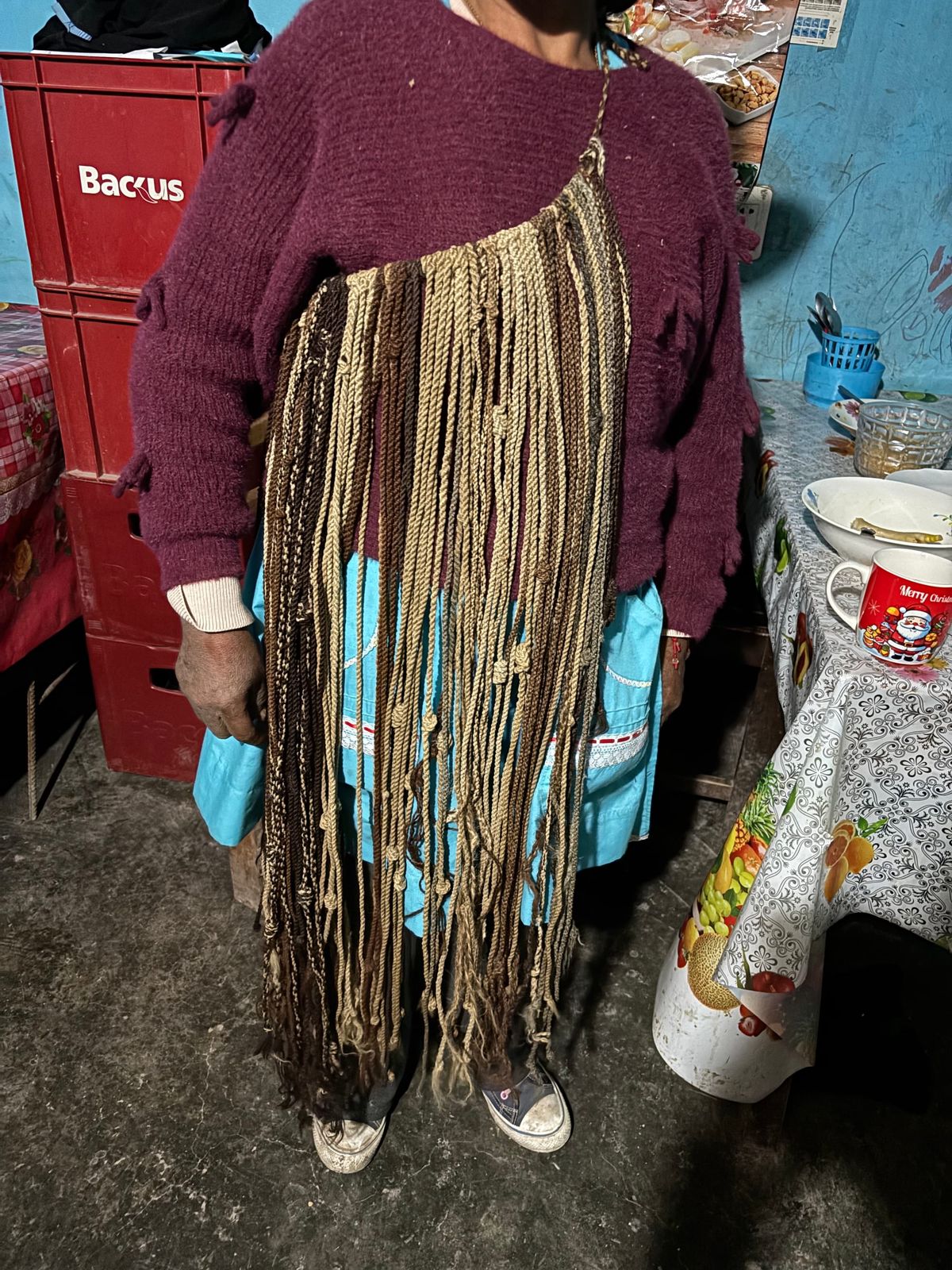
In the kitchen, where oca and rice were simmering and where workers from Tupicocha mingled with their children, I was overcome that evening by a sense of excitement. I was about to see my first khipu—used for rituals—and meet its bearer, a woman.[1]
There are no legal or archival documents in Tupicocha that state that women cannot serve as presidents of parcialidades (that is, as khipukamayuk and representatives of the ayllus for a term of one or two years). However, neither Frank Salomon, in his ethnographic work on this village,[2] nor the other Tupicochanos I interviewed could recall any other woman having held this position. Nor did this seem shocking to them, and some of the women I interviewed even expressed a desire for this practice to become more widespread in order to give women a voice.
How can we explain this historical absence and this current possibility? Part of the answer lies in the daily activities of women, which can then be compared to the typical activities of male khipukamayuqkuna. Women primarily engage in two activities: selling goods in small tiendas (shops), which allow them to obtain food and clothing, and working on the chacra (small farm and, by metonymy, any agricultural activity).
The woman who held the khipu was also the president of the first parcialidad—the oldest and most prestigious one. Her responsibilities consisted, in fact, of tending to her crops and her family, particularly her mother. She therefore had time to attend political meetings. She was able to make time for this in part thanks to her family network: her daughter ran a kitchen in her mother’s own home, and her sister owned a restaurant, allowing them to help one another out.
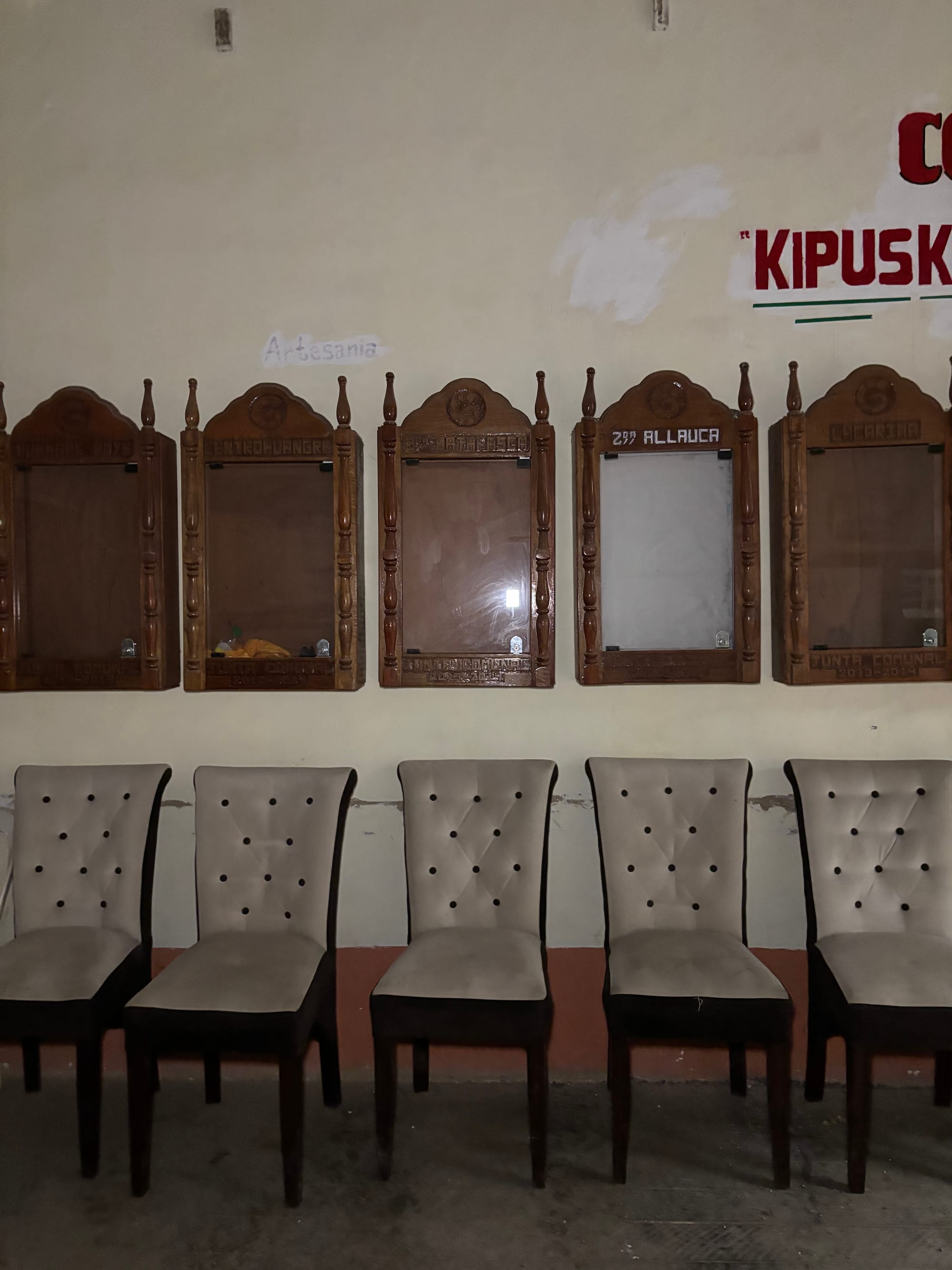
Once every two weeks, on Saturday mornings, the quipocamayos gather in the common room of the communidad. Above their reserved seats are small glass-fronted boxes indicating the name of their parcialidad, where they can store their khipu. It should be noted, however, that they never actually do this and instead keep them at home (photo by the author).
On the other hand, the agricultural work that this woman performed, when she went to the fields belonging to her family, was the same as that carried out by all the other male khipu bearers. The links between village accounting systems and agriculture had been severed in Tupicocha, at least since the first third of the 19th century, according to the village’s accessible archives. Nevertheless, a connection between work on the chacra and the role of khipu bearer appears to persist. Two reasons can be cited. First, the khipu’s primary function was to describe the agricultural economy of the parcialidad, as the people of Tupicocha told me, and as Frank Salomon had pointed out.[3] Second, in political affairs—particularly at village general assemblies—discussions regarding agricultural irrigation activities take center stage. Thus, we see a continuity between the khipu, agricultural organization, and political orientation.
While this woman is a special case, she highlights, by contrast, three factors that do not encourage women’s participation in the representation of parcialidades.
First, after completing their elementary education, young women continue their studies in Lima to find work in the capital city. While young men often follow the same path, their specialization in construction work leads them to return—either temporarily or permanently—to Tupicocha to work in that sector. In contrast, young women—whether or not they have continued their education—integrate into Lima society in fields that prevent them from returning to Tupicocha except for vacations.
Next, it is the men who do the work, mostly on the chacra. And they are the ones who, in any case, direct operations on their land. The connection described earlier between the chacra and ownership of a khipu remains a major reason for the exclusion of women from representative positions.
Finally, part of the social credibility required to gain access to important political positions depends on participation in faenas, which refers to community work carried out at the ayllu level. However, women’s lack of participation results in a shortfall in this area. Similarly, certain types of work—particularly construction—are carried out not at the community level, but through family and personal relationships. This type of work corresponds more closely to what is known as ayni, which involves the exchange of labor or services among members of the same group, based on the idea that the help received will one day be returned. Women are also absent from these mutual aid activities, which are important for subsequently selecting political representatives bearing the khipus.
This discovery at Tupicocha proved that women could be bearers of khipus. This is a surprising finding, given that we are dealing with societies in which women often perform domestic tasks, or, at least, are not politically visible. Building on this finding could teach us more about the relationship between social organization and the khipus, just as it could change the way we understand gender relations in Andean societies.


