
Three Dimensions: Reflections from a First-Time Khipu Recording

A few months ago, I had the opportunity to record khipu data for the first time at the Phoebe Hearst Museum in Berkeley, California. I wanted to share some reflections about the experience, especially given my position as a younger scholar.
The work of recording a khipu starts long before ever stepping foot inside a museum. Last August, Ashok Khosla (creator of the KFG) mentioned to me that UC Berkeley may have some khipus that needed recording. Eager to get some recording experience, I reached out to the Hearst Museum, creating a research request. I waited patiently, calling periodically. I eventually learned that the museum was closed for renovations, and that the collections managers did not have the time or space to host me.
This all changed at Berkeley's biennial Institute of Andean Studies meeting, where I had the chance to meet staff of the Phoebe Hearst Museum, including its collections manager, Melissa LaFortune. After some discussion, she graciously offered me the option to return to Berkeley a few weeks later to record the khipu.
With this news, I began to prepare for my visit. Knowing that Ashok and I would have only a few hours with the artifacts, I conversed with scholars and created a knot reference library to maximize my efficiency at the museum.
Creating a reference library meant tying each type of knot with different twists and axes. As I carefully counted the number of turns on my long knots, I felt like a modern-day khipukamayuk. This reference library was an integral part of my preparation; being able to glance at each knot variation in macro form and compare it with its miniature would vastly speed up the process of recording. Running my fingers down my paracord knot reconstructions, I realized the incredible possibility of encoding data in khipus—the sheer amount of knot combinations that exist with knots alone, and exponentially more when considering colors and patterns.
Finally, on February 5th, I made the hour-long trek up to Berkeley's Campus, meeting Ashok and beginning the process of recording Berkeley's collection. Sitting in the basement of the Phoebe Hearst Museum, Ashok and I got to work, measuring cord lengths, knot distances, and noting cord terminations. Along the way, we gathered new data, including cord twists, attachments, and Pantone color equivalents of cord coloration.
Over the course of our four-hour study session, we made good time, efficiently and accurately recording the cords on Berkeley khipus 4-5419A and 4-5419C. It was a long process, but working hands-on with these two khipus gave me a different, more tangible experience that helped me understand the tactility inherent within the reading and writing of these objects. Although we only got through two of several khipus in the Hearst Museum Collection during this first visit, I look forward to returning to complete the work.
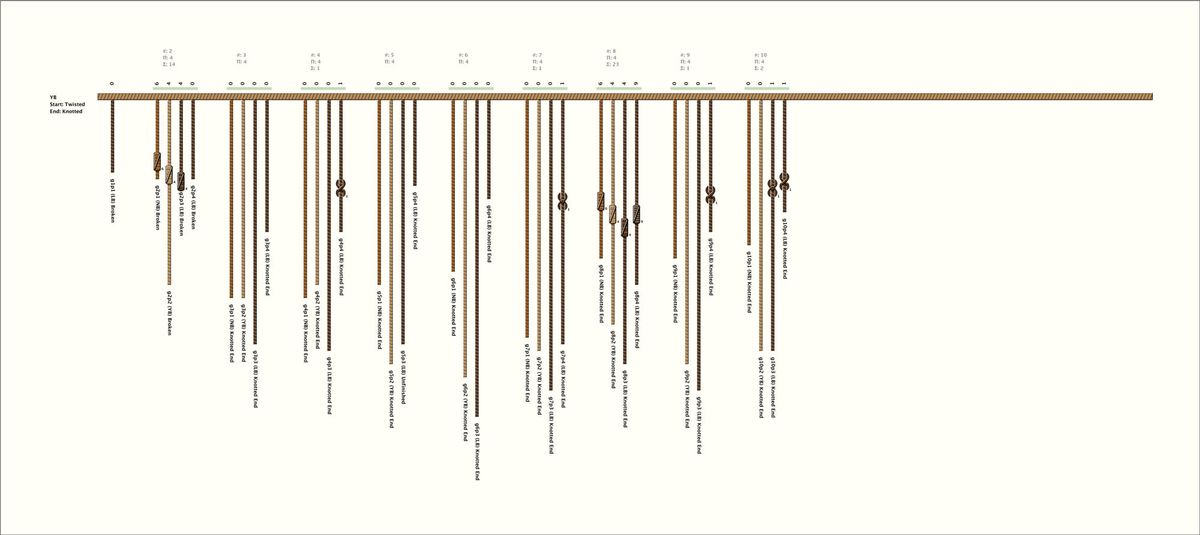
Unbeknownst to us, the khipus we had just recorded were previously recorded by Robert and Marcia Ascher in the 1980s (see Ascher and Ascher 1988). Once we had returned home and scrutinized the data, Ashok realized that the khipus we had recorded were duplicates, mapping them back to KH0220 and KH0221. We had not realized this because of UC Berkeley's recent rebranding of what was previously known as the Lowie Museum to what is now the Phoebe Hearst Museum of Anthropology. Yet, this added a unique lens to our exploration of these two khipus, allowing us to map and understand changes and discrepancies in our data.
With this in mind, my first order of action was to merge the Aschers' data with our newly gathered information, inputting twists, attachments, and adding more precise lengths and colors. These data will eventually be integrated to the KFG database, enriching future scholars' corpus- and khipu-level analyses.
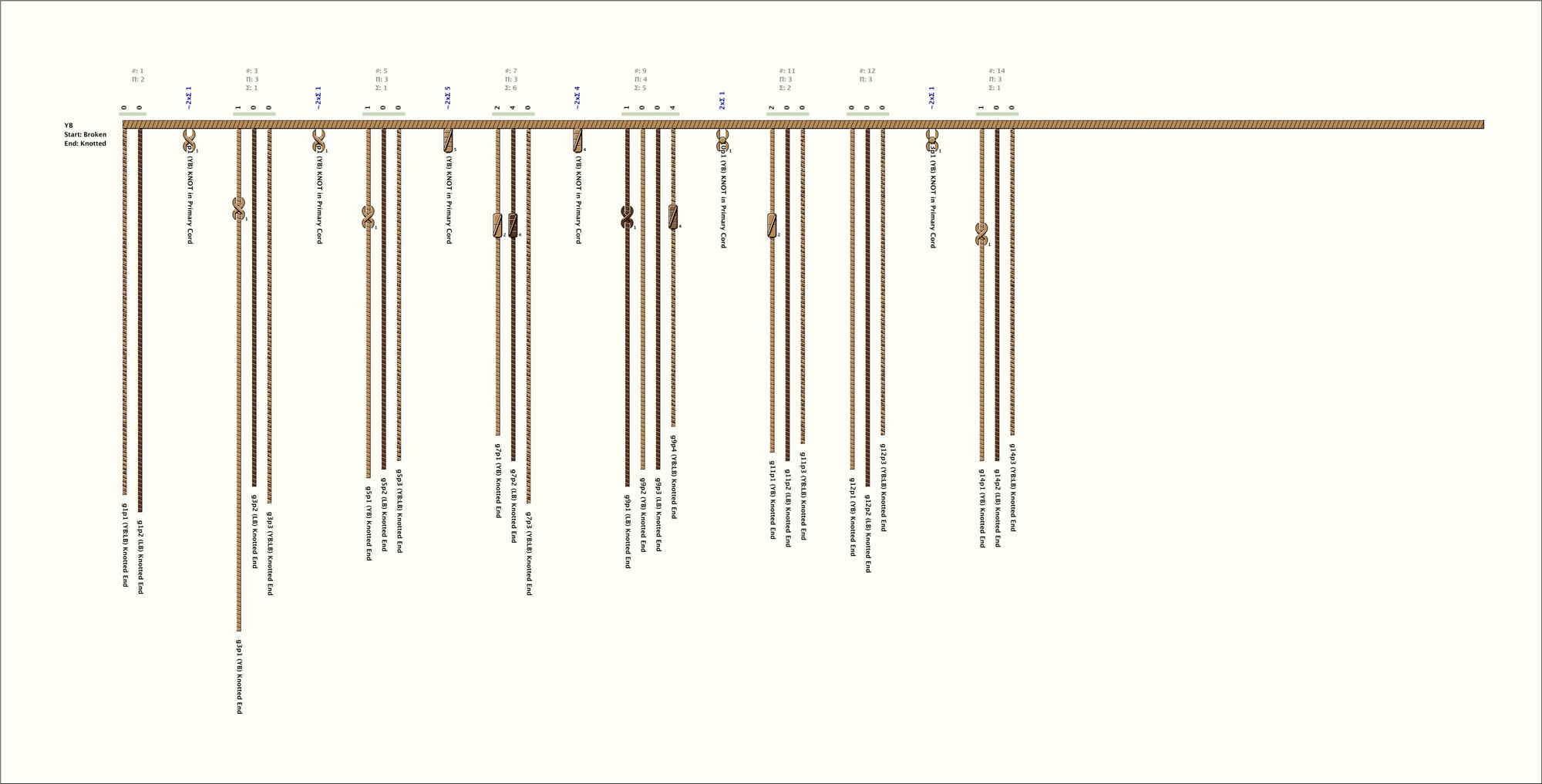
Schematic of Khipu KH0220 (used with permission of Ashok Khosla).
Misconceptions
There is a different type of learning that comes from viewing an object in person in a collection. I had several preconceptions surrounding the recording process of khipus that were quickly dispelled:
- Recording is a fast process: I was optimistic that the four hours we were allotted in the museum would be more than enough to speed through all seven khipus housed in the collection. I was quickly proven wrong. The painstaking detail required for each khipu took two hours per khipu, and these were relatively simple specimens. I cannot imagine the dedication required to record khipus that contain hundreds of pendant cords!
- Recording is an exact science: Through this process, I realized that several aspects of a Khipu are easily disputable. Consider color, for example. The Khipu Field Guide makes use of the Brezine Color Chart, giving a confined set of colors to describe a khipu. Yet, these values are not quantified, leaving color values up to the interpretation of the individual recording. I can recall more than a few instances where Ashok saw a certain color, I saw another, and the Aschers saw a third. Khipu recording leaves a lot up to interpretation, which also makes proper training in how to make these judgments incredibly important.
- Khipus can be distilled onto a 2D canvas: Working hands-on with these objects, rotating cords, I began to pick up details that I had never seen in high-resolution images. Unlike many of the texts we are used to, Khipus need to be viewed in 3-dimensional space to preserve their nuance.
Re-Recording and Why it Matters
Although the original aim of my trip to the Hearst Museum was not to re-record, my experience there underscored the importance of returning to objects.
Where Does New Data Come From?
During this visit, Ashok and I added and improved several pieces of data—the cord twists, colors, and other additional details—that were not previously recorded. As scholarship continues to examine the impact that new data points can bring to khipu studies, these data need to be retroactively added to previous entries of databases. Therefore, having the chance to visit and restudy these khipus allows us to add details that we did not know were important in the past.
Gary Urton’s 1994 study, “A New Twist in an Old Yarn,” is a clear example of how new field recording can reshape the questions scholars are able to ask. During a month-long study of the Inka khipu collection at the Museum für Völkerkunde in Berlin, Urton recorded not only familiar features such as knot type and placement, but also structural details such as spinning, plying, wrapping, and, most importantly, knot directionality. This newly recorded feature—the distinction between Z- and S-direction knots—had not been systematically documented by earlier khipu scholars. By adding this category of data, Urton was able to argue that knots could no longer be treated simply as fixed numerical signs; instead, the same numerical knot could carry additional information depending on the direction in which it was tied. His study opened a new area of research into binary patterning in khipus, showing that directionality may have functioned as part of a broader information system alongside color, number, and spacing. In this case, the act of returning to museum collections and recording a previously overlooked feature did not merely add detail to existing records; it changed how scholars thought about the khipu as a system of encoded information.
More recently, Mackinley FitzPatrick’s 2026 article “Knot Tricks” shows that even the most familiar part of the khipu—the knot itself—still has more information to yield when recorded with greater precision. FitzPatrick applies mathematical knot theory to khipu knots, arguing that certain visually similar knots may be structurally different, while other visually distinct knots may actually be topologically equivalent. This framework emerged from close reexamination of actual khipus, where FitzPatrick found that several knots previously recorded as figure-eight knots were in fact pseudo figure-eight knots. For example, at Museo Leymebamba, a khipu previously recorded with three pseudo figure-eight knots was found, after restudy, to contain seven; similarly, a Penn Museum khipu recorded by the Aschers as having thirteen figure-eight knots was found to contain at least eleven pseudo figure-eight knots. These corrections matter because misidentified knots can obscure larger patterns in khipu encoding. By collecting new knot-level data, FitzPatrick opens a new line of study focused not just on what numerical value a knot represents, but on how knot structure, variation, and transformation may have contributed to meaning. Like Urton’s work, this study demonstrates that new data collection is not a secondary task in khipu research; it is what makes new interpretations possible.
Years from now, a future scholar might return to the Hearst Museum, sit in the same chair I did, and follow the same procedure I did, this time with their own new data to collect. Advances in the study of khipus will continue to come from a deeper understanding of these artifacts, and more details will continue to solidify our ability to fully reconstruct a khipu from its data alone. I'll discuss this further in the next section.
Disagreements with Original Measurements
Khipu recording is not always an exact science; some data is left up to interpretation. Therefore, having the opportunity for several scholars to examine a khipu can only benefit the scholarly community. Each recording of a khipu presents the opportunity to find new details a previous researcher missed or did not record, and to clarify discrepancies. The more eyes on a given khipu, the more chances we have to correct mistakes and build consensus.
Furthermore, how an object looks can change with time and context. I have no way of knowing if the khipu I saw on my visit appeared the same color as it did to the Aschers decades ago. It may well look different to a next-generation researcher, decades in the future. Wear and change are a part of the history of any object, and coming back to restudy an artifact gives us a chance to track that evolution (e.g., Thompson 2024: 91-93). Even in the short-term, the color of the lighting can significantly impact the way an object is perceived, making it even harder to standardize measurements across several museums, contexts, and time periods (Milillo et al. 2023: 2357). For these reasons, the KFG has begun adopting the RGB Pantone Color book system—one already in use by Jeffrey Splitstoser and others (e.g., Splitstoser 2022; Milillo et al. 2023; FitzPatrick 2025)—which I will discuss in the next section.
New Data
As the Khipu Field Guide begins adopting the Pantone Color Book system for recording cord colors, it is worth considering whether such precision risks overcomplicating the color record relative to the original Inka system. The Inka themselves did not possess a standardized color reference comparable to Pantone, and their perception or categorization of color may have operated through broader cultural categories rather than finely calibrated tonal distinctions.
Alejo Rojas Leiva has raised a similar concern about modern analytical khipu frameworks. In his discussion of earlier recording systems, he notes that the method developed by Marcia and Robert Ascher identifies “61 colors and shades,” a level of differentiation that, he argues, “leads to an over-recording” of color variation (Rojas Leiva 2009: 261; translation by author).[1] This critique highlights how modern classification systems may impose distinctions that were not necessarily meaningful within the original khipu-making context.
Rojas also emphasizes that archaeological preservation complicates modern attempts at precise color identification. Exposure to light and chemical processes can alter dyes over time so that colors “quickly changes to a dark brown or black tone,” meaning that subtle tonal differences visible today may not reflect the original appearance of the cords (Rojas Leiva 2009: 262; translation by author).[2] From this perspective, highly granular systems such as Pantone may exaggerate distinctions that did not exist—or were not significant—when the khipus were originally produced.
At the same time, the adoption of a standardized system, such as Pantone, offers important advantages for documentation. Recording colors with greater precision allows researchers to track how closely related different cord colors are and to identify potential clusters of shades within a Khipu. If two cords appear similar but not identical, a more nuanced color record may help determine whether the difference reflects dyeing practices, manufacturing variation, or a meaningful distinction within the Khipu’s informational structure. Thus, while Pantone-based recording may risk imposing modern distinctions onto ancient materials, it also creates a more rigorous archival record that preserves subtle relationships between colors for future interpretation.
Conclusions
My first experience recording these khipus revealed that these objects resist being reduced to fixed datasets. Khipus exist as dynamic, interpretive systems whose legibility shifts across observers, lighting conditions, and time. Despite later finding out that I was not the first pair of eyes to record these two Hearst khipus, that did not diminish the sense of gratification I felt in contributing to a research database that I have drawn from over the past few years.
This experience also raises a broader question about the role of modern analytical frameworks in shaping how we understand khipus. Systems like Pantone-based color matching offer greater precision, but that precision is not neutral. By increasing the resolution of our measurements, we may also be introducing distinctions that were never meaningful within the original system. Recording, then, is not simply preservation, but translation—one that reshapes the object it seeks to describe. At the same time, abstraction comes at a cost. As khipus are translated into spreadsheets and databases, they lose much of the information embedded in their physical form—the spatial orientation of cords, the tension of fibers, and the tactile logic through which they were meant to be read.
This loss helps explain why undertakings like the “Haptic Khipu” project at UC Santa Barbara is so compelling: it attempts to restore touch as a mode of analysis, recognizing that khipus are not just visual or numerical systems, but fundamentally haptic ones that lose layers of detail when abstracted into numerical databases.
Ultimately, the future of khipu research lies in working within these tensions. Re-recording is not redundancy, but the mechanism through which the field advances—each encounter adds new data, challenges prior assumptions, and reflects evolving methods. As datasets expand, there is growing potential to analyze khipus at scale, but these efforts must remain grounded in the material realities of the objects themselves. Khipus do not simply store information; they challenge us to rethink what counts as data, and what is lost—and potentially recovered—when we translate the tactile into the digital.
Bibliography
Ascher, Marcia, and Robert Ascher. 1988. Code of the quipu. Databook II. University Microfilms International, Ann Arbor, Michigan.
FitzPatrick, Mackinley. 2025. Empire of String: Unraveling the Enigma of Inka Khipus. Executive produced by Harvard Griffin GSAS. Harvard Horizons Symposium. 08:27. https://www.youtube.com/watch?v=eJgOmOUK5aE.
FitzPatrick, Mackinley. 2026. “Knot Tricks: What Mathematical Knot Theory Can Reveal about the Structure of Khipu Knot Encoding.” Latin American Antiquity, ahead of print, March 30. https://doi.org/10.1017/laq.2026.10171.
Milillo, Lucrezia, Marei Hacke, Sara Norrehed, Ilaria Degano, Francesca Gherardi, and Ellinor Gunnarsson. 2023. “Heritage Science Contribution to the Understanding of Meaningful Khipu Colours.” Heritage 6 (3): 3. https://doi.org/10.3390/heritage6030124.
Rojas Leiva, Alejo. 2009. “La construcción y el registro universal del quipu inca.” In Actas de las IV Jornadas Internacionales sobre Textiles Precolombinos, edited by Victòria Solanilla Demestre. Universitat Autónoma de Barcelona.
Splitstoser, Jeffrey C. 2022. “A Comparison of Two Knotted-Cord Fabrics: An Inka Khipu and a Costa Rican Census.” The Textile Museum Journal 49 (1): 134–57. https://doi.org/10.1353/tmj.2022.a932845.
Thompson, Karen M. 2024. “A Numerical Connection Between Two Khipus.” Ñawpa Pacha 45 (1): 83–104. https://doi.org/10.1080/00776297.2024.2411789.
Urton, Gary. 1994. “A New Twist in an Old Yarn: Variation in Knot Directionality in the Inka Khipus.” Baessler-Archiv Neue Folge 42: 271–305.
Urton, Gary, and Carrie J. Brezine. 2005. “Khipu Accounting in Ancient Peru.” Science 309 (5737): 1065–67. https://doi.org/10.1126/science.1113426.


