
New article out on knot shapes and how to make sense of them (FitzPatrick 2026)

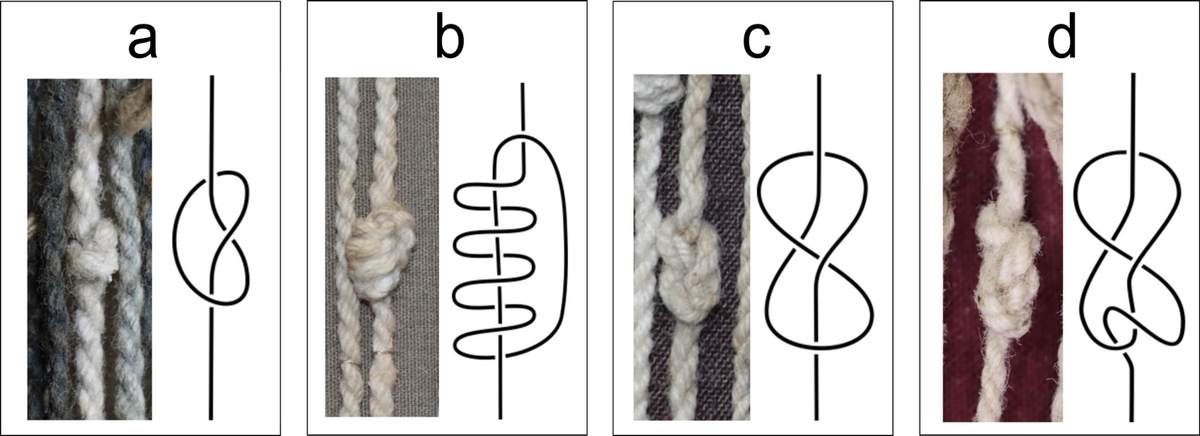
In this space, we occasionally highlight new publications of interest to readers. Our blog editor Mackinley FitzPatrick has just published a new paper in Latin American Antiquity about mathematical knot theory and its application to the study of khipus. Anyone can access an open version here.
FitzPatrick’s paper asks what more can be learned from khipu knots if researchers pay more attention to theory from other fields, namely mathematics, by applying topology to khipus. He tackles the shapes of knots in terms of both how they are created and how they might be read. And he looks at the history of studying knot shapes and knot types to point khipu researchers toward future directions.
As FitzPatrick points out, most studies of khipu knots have focused on the (inferred) values of the knots, which are typically calculated using the position, type, and/or number of turns of the canonical knot shapes[1]. However, counting mistakes occur, and knot forms are mis-recorded at times. Another focus of khipu scholars is knot directionality or twist[2]—“S” and “Z” directions, which have been hypothesized as meaningful to khipu decipherment.
By scrutinizing knot morphology closely, FitzPatrick has been able to identify exceptions, anomalies, and misidentifications in ways that are rewriting the khipu record. For example, looking at occurrences of figure-eight knots on khipus whose data were already registered in digital databases has revealed multiple cases of pseudo figure-eight knots, which potentially changes the values identified on these khipus but certainly changes the interpretation of their making and use as well.[3]
How can topology be applied to khipus?
The nature of knots and their potential to be altered on a cord is relevant to makers and students of the khipu. Much meaning is made of how knots appear at the moment they are studied, yet FitzPatrick shows how some kinds of knots can be deformed or reformed after being tied. This can complicate efforts to understand khipus and their meaning. And it propels students of the khipu to look beyond straightforward “knot values” alone (e.g., a long knot has eight turns and therefore signifies the value “8” and nothing more).
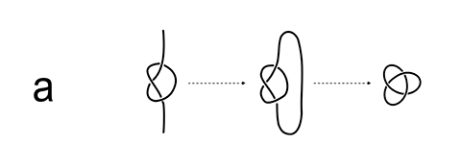
Part of FitzPatrick's figure 2 from the paper (2026), showing how to convert a "real-world" overhand knot into its mathematical counterpart.
An illustration from the article visualizes how to convert a “real-world” knot into a mathematical knot. The two “loose” ends of a knot are joined to make it continuous, since for a “mathematical knot” there is no beginning or end. As FitzPatrick explains, “once a knot has been created (i.e., tied), any deformations or changes made to it will not alter the specific knot type it is classified as, so long as the deformations do not cut or cause any part of the knot to pass through any other part of itself. Thus, after a knot is tied, an infinite number of variations of it exist” (2026, 4). A useful analogy here is that of a sweater: no matter how much you twist around a sweater’s torso and arms, as long as it is not torn, it still maintains its primary shape and can return to that shape. The key takeaway is that a single mathematical knot type can take on many visually different states, yet, topologically, these visually different states still belong to the same underlying knot type.
To understand the application of topology to khipus, one must also differentiate chiral and amphichiral knot types. Some common khipu knot types, like long knots, are chiral—manipulating their shape will not change their directionality. They will still be read as “S” or “Z” knots when physically manipulated. Figure-eight knots, however, are amphichiral, and so their directionality can be altered. When we say their directionality can be altered, we mean that the visual appearance of knot directionality can be altered by what FitzPatrick calls “capsizing” (altering the knot on its cord by manipulating its shape without untying or cutting it).
How should khipu scholars adjust our approaches to recording?
FitzPatrick argues that the specific state of a capsized knot, when diverting from the canonical long knot or figure-eight knot forms, matters and should be recorded. He shows that there are at least eight notable variations of the figure-eight knot that can be created by capsizing. The long knot has at least six noteworthy transformations as well, although it is chiral and thus, its knot twist is not changeable as with the amphichiral figure-eight knot. With these examples of transformations and capsizing, the article demonstrates that observing and systematically recording khipu knots is more complex than most would assume.
In his explanation of the broader implications of applying topology to Inka khipu knots, FitzPatrick explains that it would be difficult to accidentally capsize or manipulate a knot in ways that would give it a different visual appearance or that would, in the case of the figure-eight knot, change its twist from S to Z. At the same time, being able to change the state of a knot without untying it is a move that khipukamayuqs may have exercised to alter information. Researchers have also observed evidence of untied knots on khipus ("ghost knots"), but other manipulations have not been explored before this article.
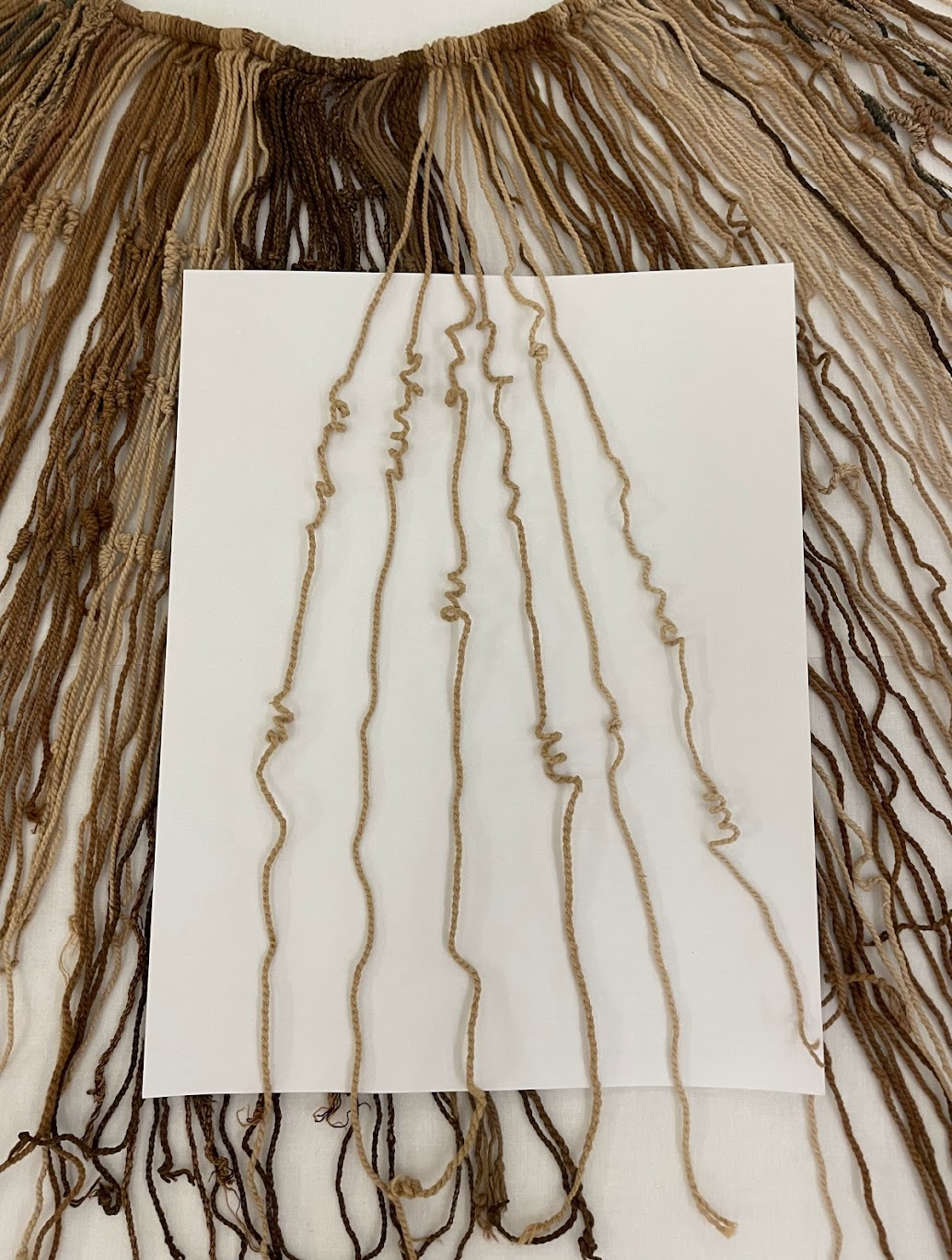
Mack FitzPatrick's photograph of "ghost knots" found on khipu PC.WBC.2016.071 in the Dumbarton Oaks Museum, Washington, D.C.
This paper offers greater insight into khipu construction and the use-lives of khipus. It shows that there are relationships between the myriad knot types that khipu researchers have recorded and named over time, and that one can and should systematize how they are recorded. It is also a needed reminder that seemingly binary attributes of khipus are more complex and warrant ongoing hypothesis-testing about how to “read” them. Khipu analyses that presume numerical values are straightforward must reconsider the complexities in other features of knots if we are to hope to better understand this Andean technology.
Inka-style khipu knot values are typically calculated using the base-10 positional system first laid out by Locke (1912). ↩︎
In this paper, FitzPatrick joins Jeffrey Splitstoser (2022) in using the term “twist” rather than “direction”, referring to the way the knot twists around its cord as it’s tied. ↩︎
Karen Thompson has previously documented differences in how researchers have separately observed and recorded attributes of various khipus (2024). ↩︎
References
FitzPatrick, Mackinley. 2026. “Knot Tricks: What Mathematical Knot Theory Can Reveal about the Structure of Khipu Knot Encoding.” Latin American Antiquity, March 30, 1–17. https://doi.org/10.1017/laq.2026.10171.
Locke, L. Leland. 1912. “The Ancient Quipu, a Peruvian Knot Record.” American Anthropologist 14 (2): 325–32. https://www.jstor.org/stable/659935.
Splitstoser, Jeffrey C. 2022. “A Comparison of Two Knotted-Cord Fabrics: An Inka Khipu and a Costa Rican Census.” Textile Museum Journal 49: 134–57. https://doi.org/10.7560/TMJ4908.
Thompson, Karen M. 2024. “A Numerical Connection Between Two Khipus.” Ñawpa Pacha 45 (1): 83–104. https://doi.org/10.1080/00776297.2024.2411789.


