Recent khipu research featured at the San Francisco meetings of the Society for American Archaeology

The 91st meeting of the Society for American Archaeology (SAA) was held in San Francisco, California from April 29th to May 3rd this year. Members of the Khipu Field Guide (KFG) team and collaborators were there to present on recent research and the ongoing outreach efforts of the KFG.
Researchers did not only present on Inka khipus, but also earlier Middle Horizon khipus. In a session on color in the Ancient Americas, sponsored by the Fiber Perishables Interest Group, Jeffrey Splitstoser (George Washington University) outlined problems with the study of color among Wari khipus. His paper demonstrated that methods for measuring and comparing colors present a variety of challenges for researchers and for interpretation of khipus. His paper also offered preliminary results from color analysis of Wari khipu samples that indicate that minor differences in color (e.g., light versus medium blue) might be immaterial differences when it comes to color meanings.
Another symposium, “Knots, Glyphs, and Data: The Landscape of Modern Decipherment in the Ancient Americas,” was sponsored by the Pre-Columbian Society of Washington, DC and organized by Jeanette Nicewinter and Megan Leight. It featured multiple presentations by KFG team members about khipu presented alongside papers on Maya glyphs and decipherment. The symposium was intended to enhance cross-regional dialogue between khipu and glyph researchers, to identify common challenges and strategies, and to compare processes. The session offered a space for researchers who do not normally talk to each other about their work to learn from each other.
While the Open Khipu Repository and Khipu Field Guide are hubs of research for the Andes, Maya glyph researchers also collaborate through open access data sources such as the Maya Hieroglyphic Database, the Script Encoding Initiative. Maya writing researchers in the SAA session discussed the creation of tools for digital access and outreach that are enabling broader understandings of political histories, sociocultural diversity, and more. As collaborative digital efforts to decipher and contextualize Maya writing have a longer history than that of khipu studies, there is yet much for Andeanists to learn from our colleagues.
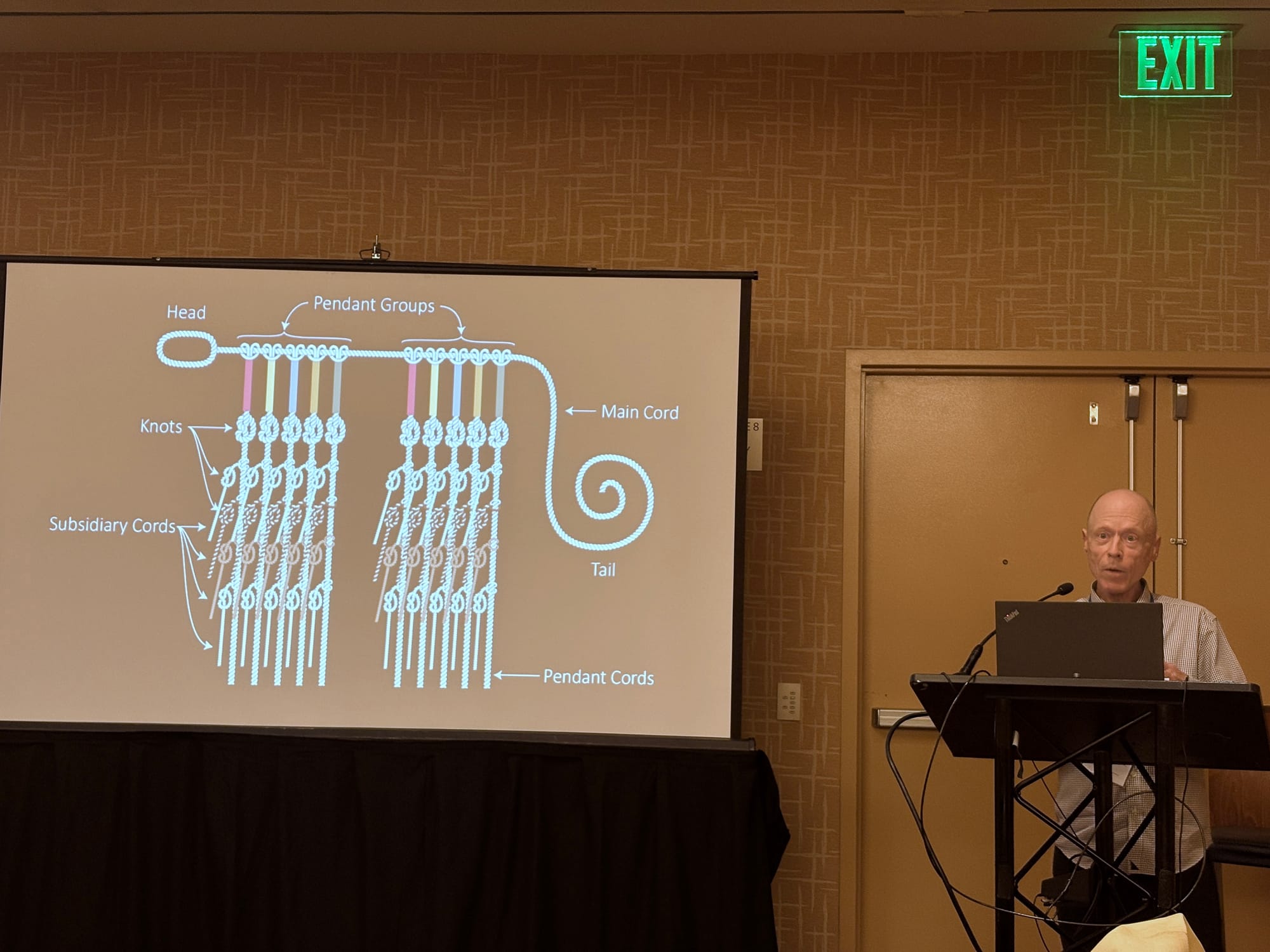
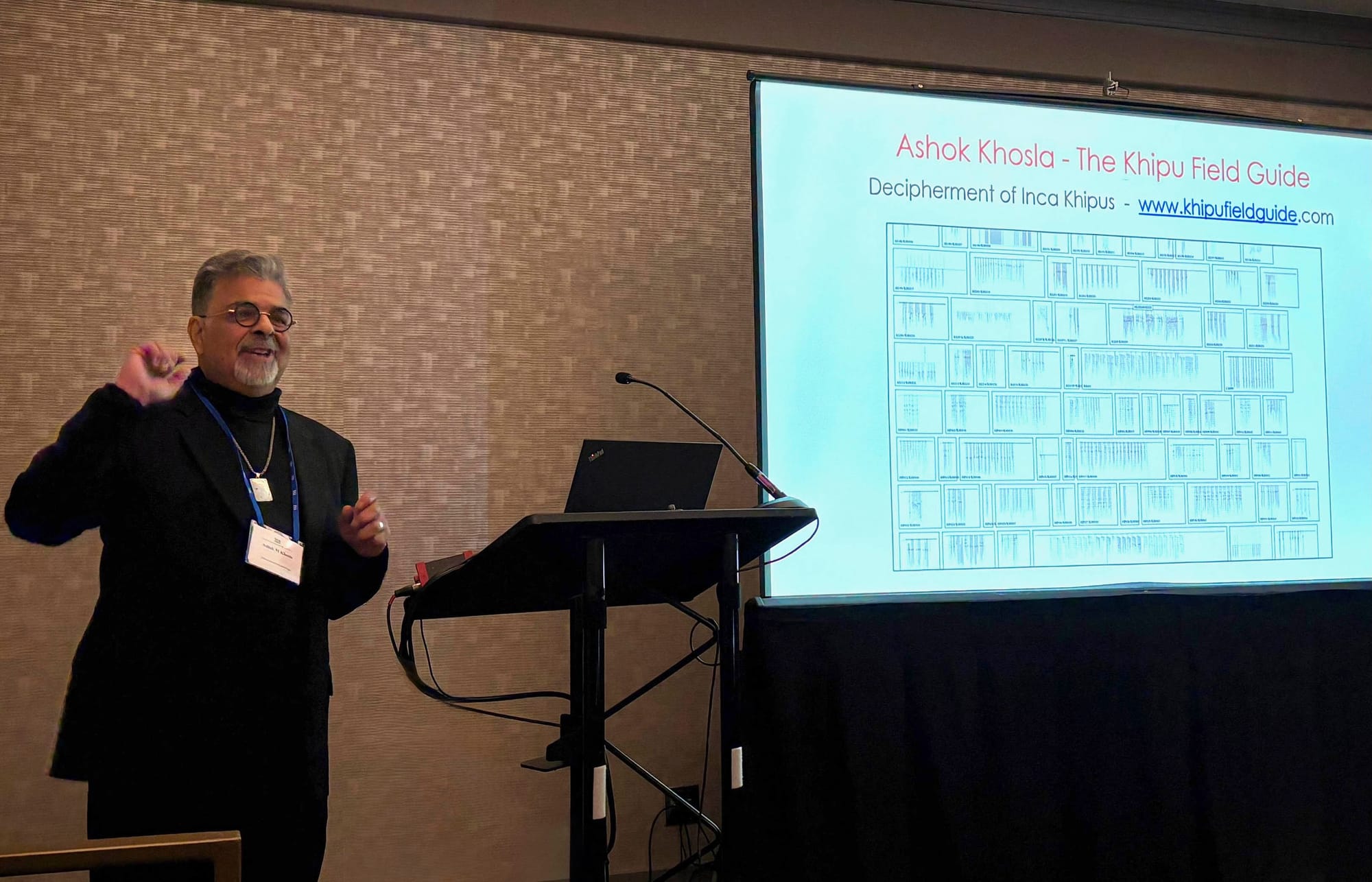
Among the khipu researchers, papers outlined current efforts to study khipus from multiple perspectives. Karen Thompson’s (University of Melbourne) presentation offered a much-needed primer on attributes of khipus as they are currently understood, as well as acknowledgment of the complexities facing researchers in terms of what is not well understood yet about how khipus were created, used, and made meaningful. In describing the current state of khipu studies, Thompson noted that moving forward, khipu researchers must focus on “data harmonization and data quality reviews.” As a follow-up, Ashok Khosla (www.khipufieldguide.com) described how the KFG team of scholars and artists from multiple disciplines are combining efforts to (visually) document the khipu corpus and promote study of extant data toward continued analysis.
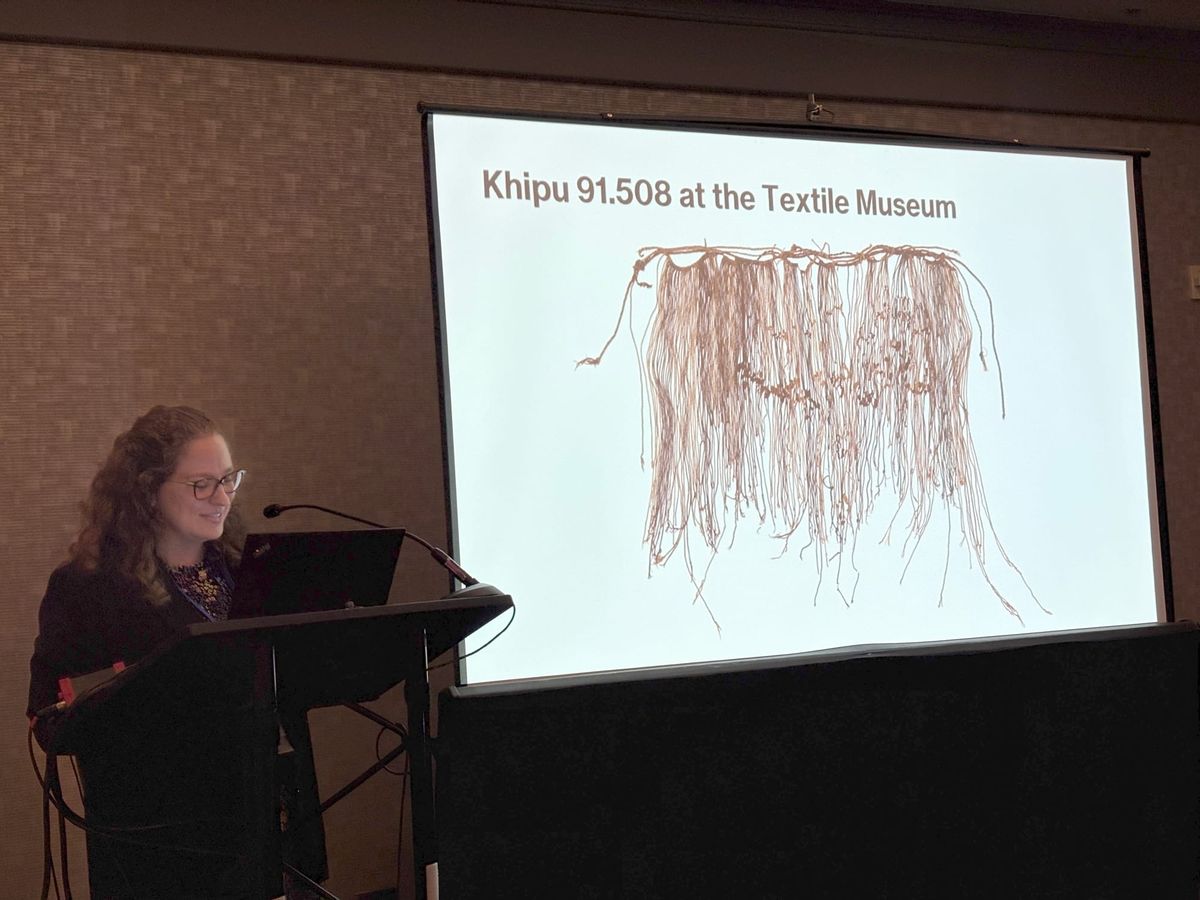
Two other khipu papers in the SAA session built on Thompson and Khosla’s introductions. Jeffrey Splitstoser and Kylie Quave (George Washington University) discussed ongoing comprehensive analysis of a single khipu at the Textile Museum as an example of “slow science.” They discussed the need to focus on evidence from khipus that can tell us more about who made them and why, including the details of cord construction, for example. They discussed resistance to the temptations of “big data”, which might obscure variability in the making and use of khipus and thus undermine decipherment efforts.
Mackinley FitzPatrick’s (Harvard University) presentation offered nuanced consideration of the possibilities and problems of digitization. He noted that a century of data-driven decipherment has in some ways flattened khipu diversity, making a plea for continuing to observe and record attributes that are difficult to digitize. His recording of 7000 cords from the Laguna de los Cóndores collection of Leymebamba offered examples of the richly divergent variables that must be accounted for as khipu scholars enter their second century of data-driven decipherment.
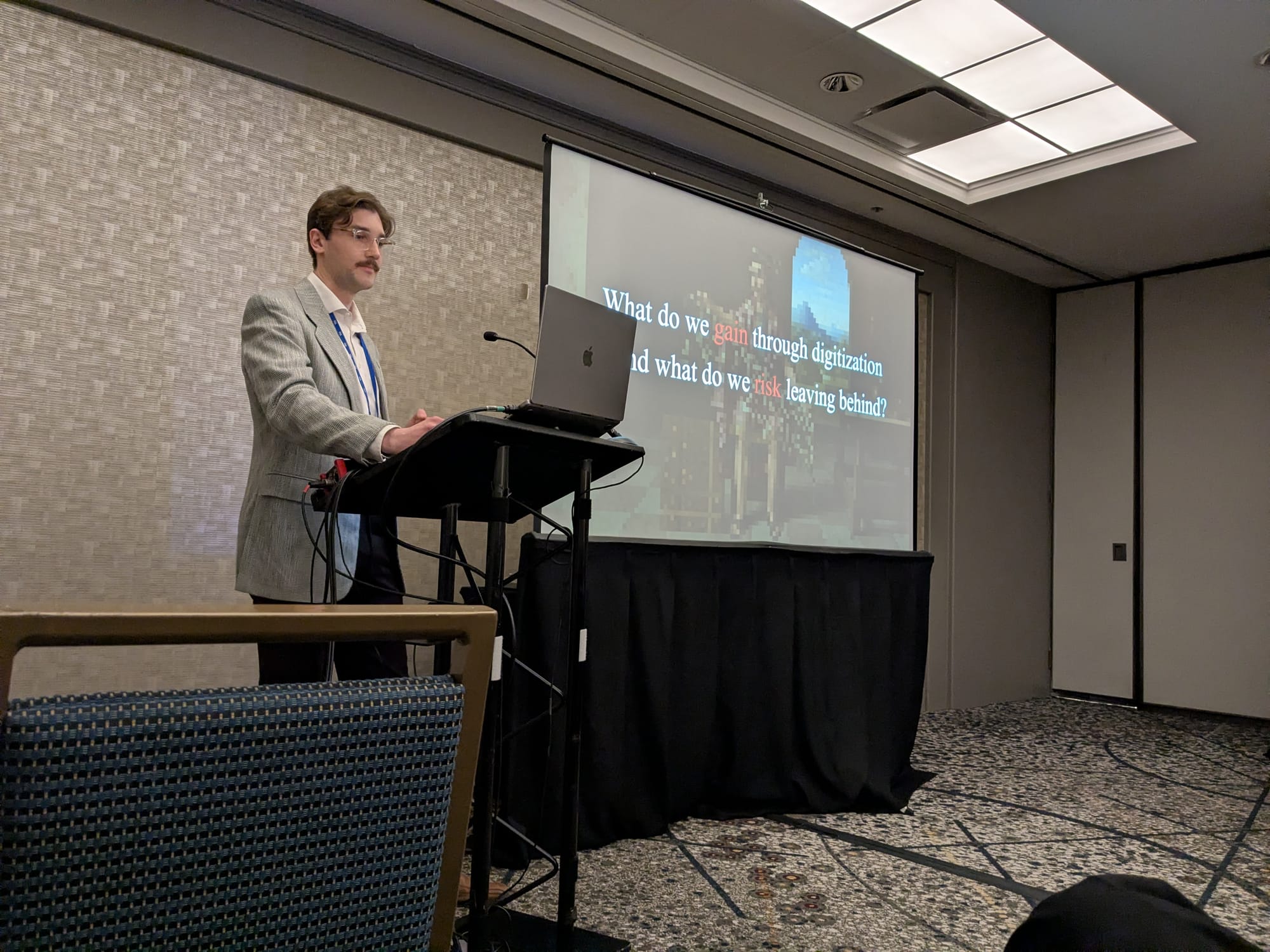
Two of the SAA presentations have been shared as open-access resources. FitzPatrick’s paper can be viewed on YouTube, while Thompson recorded hers and has posted it on FigShare.
The full SAA program and abstracts are available as well, and we have copied the titles and abstracts of the conference’s five khipu papers below:
Karen Thompson — “Khipus: What We Think We Know and What We Want to Know (and How We’re Trying to Find Out)”
Khipus have long intrigued scholars for their role in recording and communicating information outside the bounds of writing systems recognized by Western traditions. Khipus are increasingly understood as complex, information-rich artifacts that almost certainly recorded numbers and potentially encoded linguistic data. This session offers a primer on the current state of khipu decipherment studies, grounding newcomers in established interpretations while highlighting the field’s many open questions. What do we think we know about how khipus worked? After almost a century of research, much remains uncertain. Can their structure and materiality be decoded systematically, or does the diversity of the small group of surviving examples limit us intractably? To explore these challenges, researchers are drawing on interdisciplinary approaches—open scholarship, data science, computational tools, and cohort-level statistical analyses. This session surveys these emerging approaches and the questions driving them. By critically examining both our knowledge and its limits, we aim to foster interdisciplinary dialogue and invite broader participation in the ongoing effort to understand and celebrate the intellectual depth and social sophistication of precolumbian Andean peoples.
Ashok Khosla — “The Khipu Field Guide: Decipherment of Inca Khipus”
The KhipuFieldGuide (KFG) is an open-access digital repository dedicated to the decipherment of Inca khipus, or knotted records. The KFG illustrates how software design principles, coupled with a multidisciplinary team of scholars, can accelerate the decipherment of ancient information systems in the digital age. Conceived by computational linguist and independent scholar Ashok Khosla, the KFG was seeded with consolidated datasets from earlier scholarship, Its holdings are now being continually expanded through the addition of newly documented khipus with continuous reassessment of its legacy data. Unlike decipherments based on bilingual corpora, khipus lack a parallel “decoded” output. The KFG team’s progress has relied on interdisciplinary team collaboration—archaeology, anthropology, linguistics, and software design—combined with structured reasoning and visual-statistical analysis. Driven by its research team, the KFG now functions as a comprehensive platform offering the world’s largest curated open-source khipu dataset, search utilities, annotation of signs and quantitative features, data-driven visualization, statistical measurement, and an extensive bibliographic apparatus. With our technical and organizational foundations now firmly established, our objective is to expand the corpus at scale and to provide others with the resources, education, and analytic tools necessary to accelerate the decipherment of khipus.
Kylie Quave and Jeffrey Splitstoser — “When Data Tangles: Data Quality and the Future of Big Data in Khipu Studies”
The proliferation and accessibility of computational methods present many opportunities for larger-scale analyses of Inka khipu. Simultaneously, khipu are recorded by researchers who are trained differently, employ varying recording protocols, and prioritize distinct attributes, leading to gaps, inconsistencies, and incompatibilities across datasets. Even seemingly straightforward measurements—cord length or knot values—are recorded inconsistently, while knot typologies and anomalous features are described in idiosyncratic ways. Color is subject to uneven categorization and prone to fading and staining. As perishable artifacts, khipu deteriorate, complicating data integrity. Moreover, current data analyses require a khipu is reduced into a matrix of observable traits, while some khipu resist attempts to confine their materiality in boxes. We each collected data from a single khipu, documenting qualitative (fiber, attachment orientation, knot twist, cord structure, color, etc.) and quantitative attributes (instrumental color values, cord diameters, knot values, etc.) and ways that our observations diverged in the process. We highlight discrepancies in individual recording outcomes from ours and other studies to reflect on khipu data quality. Considering the treatment of the khipu corpus as “big data,” we argue for a “slow-science” approach that prioritizes methodological transparency, replication, consensus-building in recording practices, and caution in interpreting results.
Mackinley FitzPatrick — “Khipu Knots and Data Plots: Materiality in a Digital Age”
With the digital turn squarely upon us, archaeologists are increasingly amassing large datasets and applying computational tools, from data science to artificial intelligence. This presentation examines what can be gained from this digital revolution—and what we must be careful not to leave behind. Using khipus—Andean knotted-cord records—and ongoing decipherment efforts as a case study, this presentation explores how we might bridge the gap between material things and their digital snapshots. Khipus are unique not only for what they encode, but because the information they record is inseparable from the medium itself. Their tactile nature and material irreducibility make them an ideal lens for reflecting on the promises and pitfalls of digitization. In what ways can the digitization of khipus, as well as other archaeological datasets, benefit from a material-based approach? And how might material study, in turn, be enriched by digital methods? In an era of expanding digitization and increasing pressures toward standardized, machine-readable data in archaeology, what role does materiality—with all its imperfections—still play? And what risks do we run if we strip it away?
Symposium • Knots, Glyphs, and Data: The Landscape of Modern Decipherment in the Ancient Americas (Organized by Jeanette Nicewinter and Megan Leight)
In recent decades, decipherment work across the Americas has been transformed, particularly in Mesoamerica and the Andes. Continued systematic data collection and the growing availability of digital resources have generated large-scale corpora, making the study of precolumbian records more accessible than before. At the same time, new approaches leveraging data science, artificial intelligence (AI), and machine learning (ML) are being used to analyze, classify, and predict patterns in these ancient records. These methods are emerging alongside a rise in interdisciplinary collaboration, bringing together universities, museums, independent scholars, and data scientists. Collectively, these advances hold the potential to significantly accelerate decipherment efforts and generate new insights into the histories and cultures of the ancient Americas through their own records. Rather than reinforcing disciplinary divisions—such as those between Mesoamerican epigraphy and Andean khipu studies—this integrated session brings together scholars working on decipherment across regions into a single forum. In doing so, it will highlight shared challenges and foster cross-regional dialogue in the ever-growing landscape of precolumbian scripts and communication systems. We welcome contributions that employ computational methods, including the creation of digital databases, novel approaches to script recognition and analysis, encoding, and broader reflections on the implications of technology for precolumbian studies.
Jeffrey Splitstoser — “Chromatic Logics: Color and Meaning in Wari Khipus”
Color is one of the most striking and least understood features of Wari khipus, the earliest known examples of Andean knotted-cord records. Wari khipus employ an extensive range of chromatic techniques and strategies—wrapping, patterning, and seriating cords—to organize and emphasize information. Groups of knots are often distinguished not only by placement or structure but also through deliberate use of contrasting hues. Recurring patterns involving red camelid fiber and white cotton suggest meaningful hierarchies that resonate with color practices in Andean weaving and other perishable arts. This paper explores how Wari khipu-makers integrated color as a key element in both the visual and informational design of their devices.


