Untangle, But Never Untie
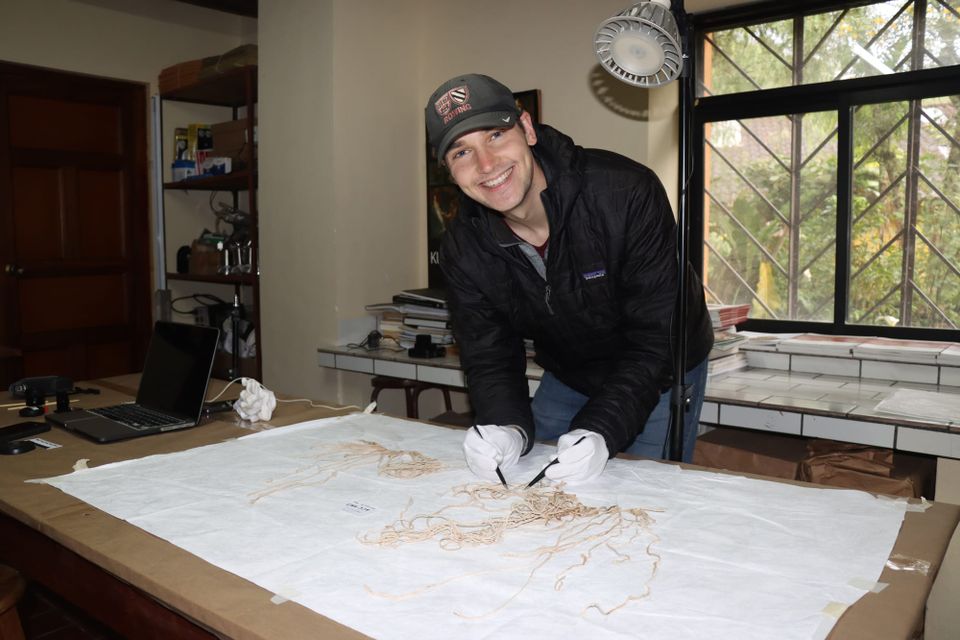
When I first began working with the collection of khipus housed in Museo Leymebamba, Peru, I was under the impression that, since their discovery around Laguna de los Cóndores more than two decades earlier,[1] they had all been untangled and sewn onto textile backings for display and easier storage. Nearly all had been.
Yet as I sat in Museo Leymebamba’s collection storage area, working my way through the list of khipus noted in the museum’s accession log alongside Wilder, who manages the collections, we came across a small paper bundle labeled “quipu” that had not been mounted. We carefully opened the outer brown paper wrapping, and uncovered an internal layer of white acid-free archival paper. Cautiously peeling back the final thin layer revealed a tangled mass of tan cords and knots.
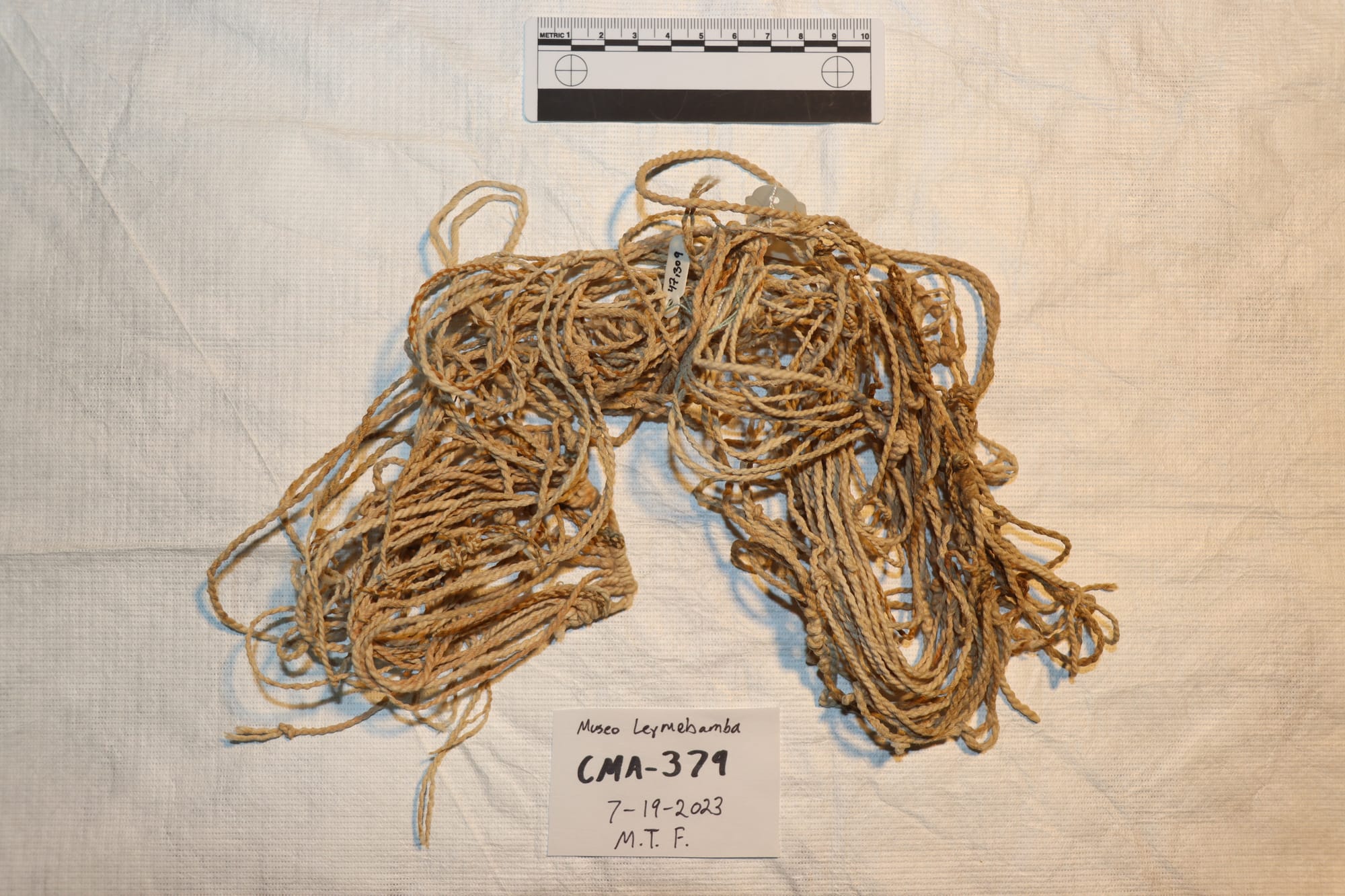
Museo Leymebamba khipu CMA-379 before being untangled.
I was stunned. When I arrived at Museo Leymebamba, my goal had been to inventory and record every khipu housed there for my dissertation, but I had not expected to encounter one still completely tangled. All of the khipus I had examined and documented up to that point, in museums in both Peru and the US, were either sewn onto canvas backings or neatly laid flat in archival storage boxes.[2]
Wilder and I spent a few moments contemplating over the mass of cords, before going to consult Dr. Sonia Guillén, the museum’s director. “Someone has to untangle it,” I remember Sonia saying to Wilder and me. “Then we can prepare it for mounting, like the rest.”
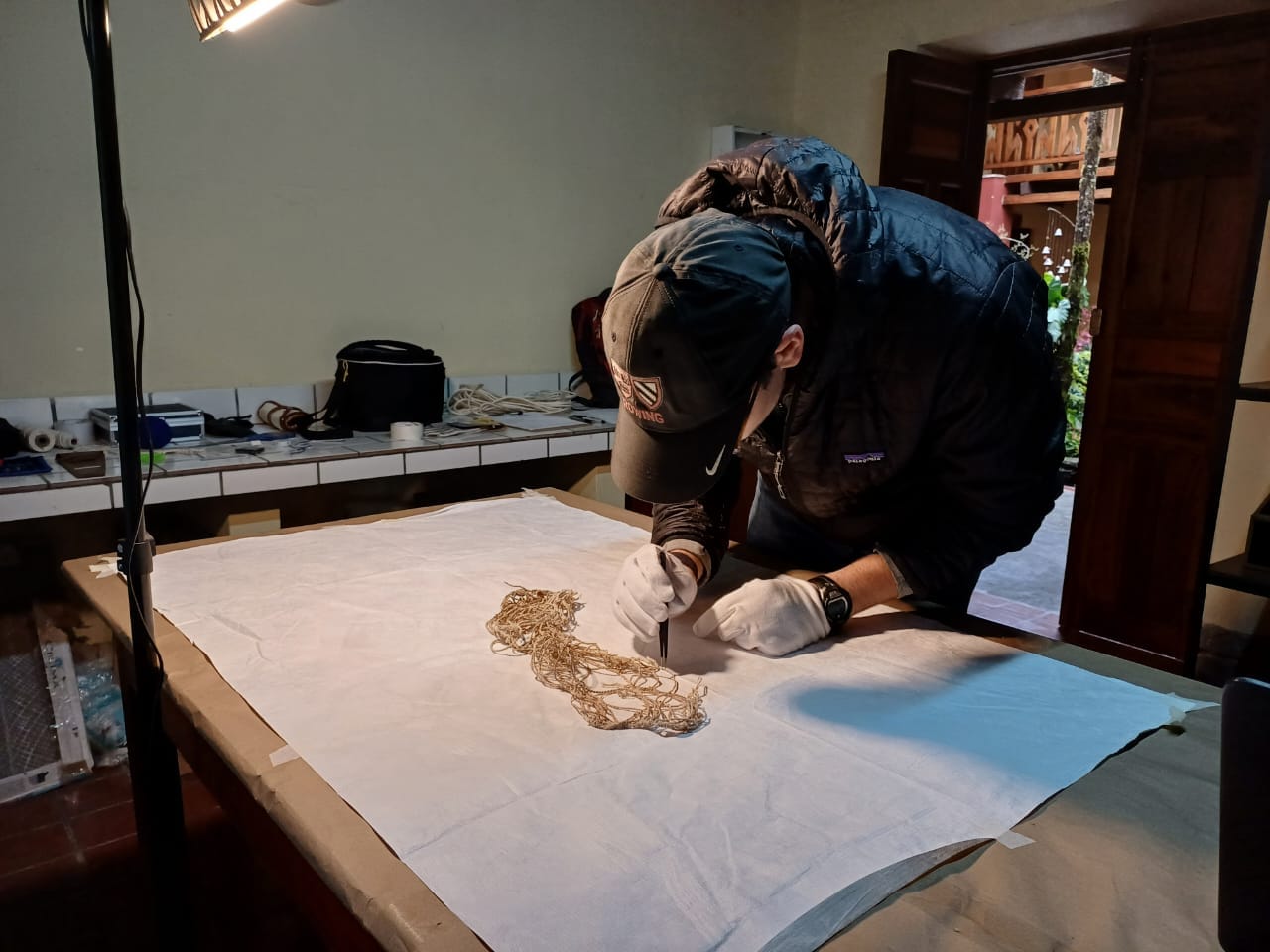
Mack carefully begins to untangle the mass of strings and knots.
I had no idea what to expect from the process that would follow, though I was already accustomed to the long hours spent bent over a khipu,[3] slowly working cord by cord and recording its structure. Occasionally, a strand might need to be shifted or passed over its neighbor to restore order. But I had never needed to untangle an entire khipu from a jumbled mass before even beginning to study it.
After conferring with Sonia a bit longer, Wilder and I carefully shuttled the bundle of cords from the collections storage area to a small room in the museum that we were using as a makeshift khipu laboratory. There, we were joined by my assistant for that summer, a local university student named Giovana,[4] who helped us carefully slide the cords out of their paper container and onto a table.
We looked down at the jumbled mass before us. After a brief moment, Wilder turned to me grinning. He gave me a pat on the back, as if to say “good luck,” as he quickly exited the room.
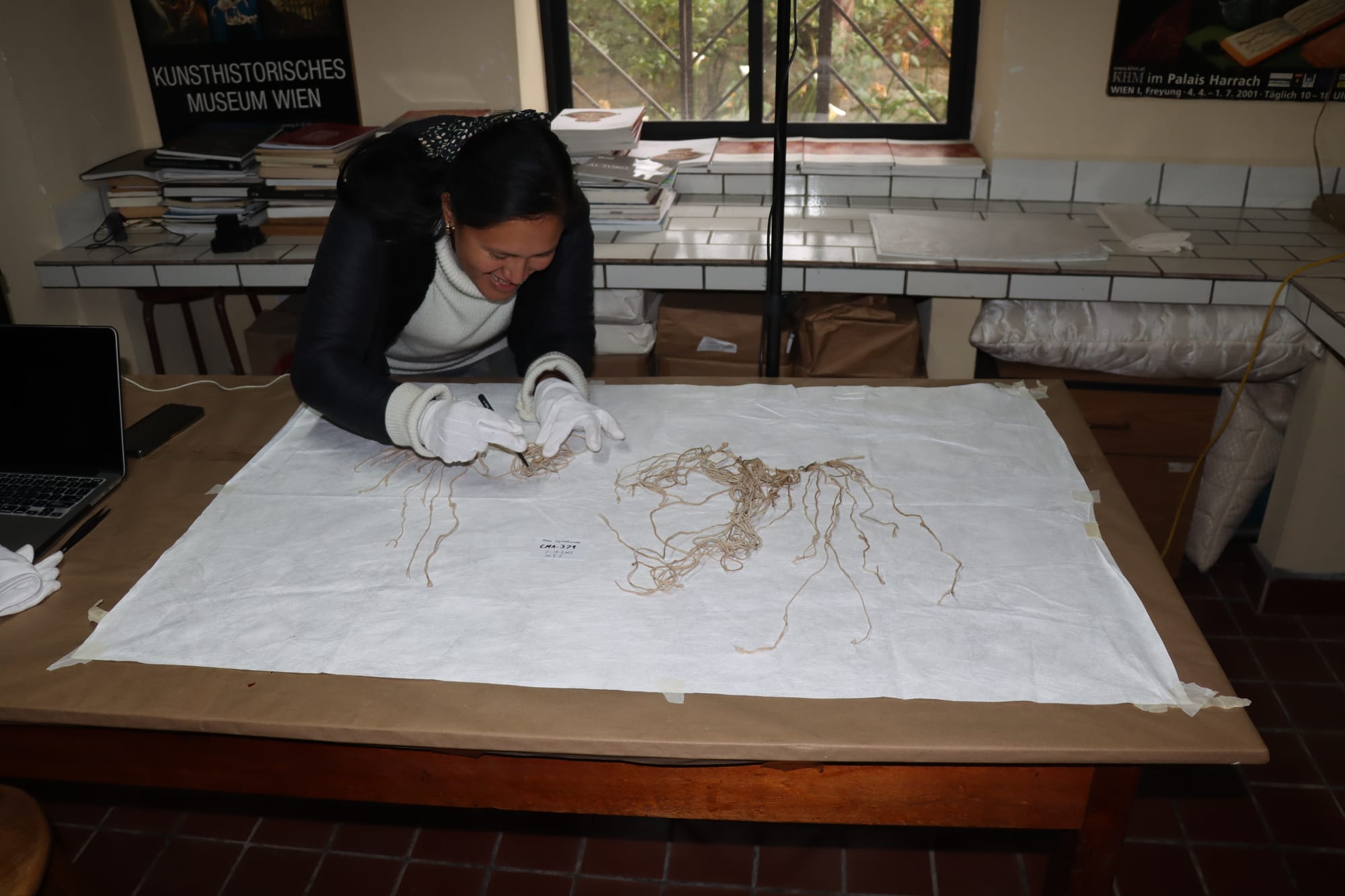
Giovana continues to untangle CMA-379, as the mass of cords slowly turns into three separate khipu fragments.
I took a deep breath and looked over to Giovana, who I saw was doing the same; then we got to work. We made sure to document our progress as we went, photographing the khipu before, during, and after it was untangled.
As we began, I realized that this was not simply a technical task. I had never untangled a khipu before, and I needed to establish a few ground rules—for both Giovana and myself. I knew of other researchers and curators who had untangled khipus before me, though with varying ideas of what it meant to prepare a khipu for study or display. Khipus have been unrolled,[5] cords have been cut,[6] linked primary cords untied,[7] and pendant cords shifted along the primary cord[8] to make them appear more “orderly,” “presentable” for exhibition, or “easier” to study. All of these interventions shocked me—and continue to do so—when I read about them, learned of them, or encountered their effects in museum collections.
Now, tweezers in hand, staring down at the tightly balled mass of cords in front of me, I wondered whether I was about to commit the same kinds of transgressions that others before me had carried out, knowingly or not. I thought carefully about what unsettled me so deeply about the many different alterations I had read about and seen. For me, it was the loss of context—the transformation of a khipu into a form that could never again be re-rolled, re-linked, or re-spaced as its original maker, its khipukamayuq, had intended.
Reflecting upon this, I codified a rule I follow when working with khipus: untangle, but never untie. If any part of a khipu is knotted, linked, secured, or otherwise tightly bound, it is best practice—in my view—to leave it as found. Some might argue that this approach could hinder accurate recording, and therefore the “reading,” of a khipu. To them, I would respond that we have far more khipus that have already been unrolled and unlinked awaiting close study than those that still preserve their original appearance and structural context.
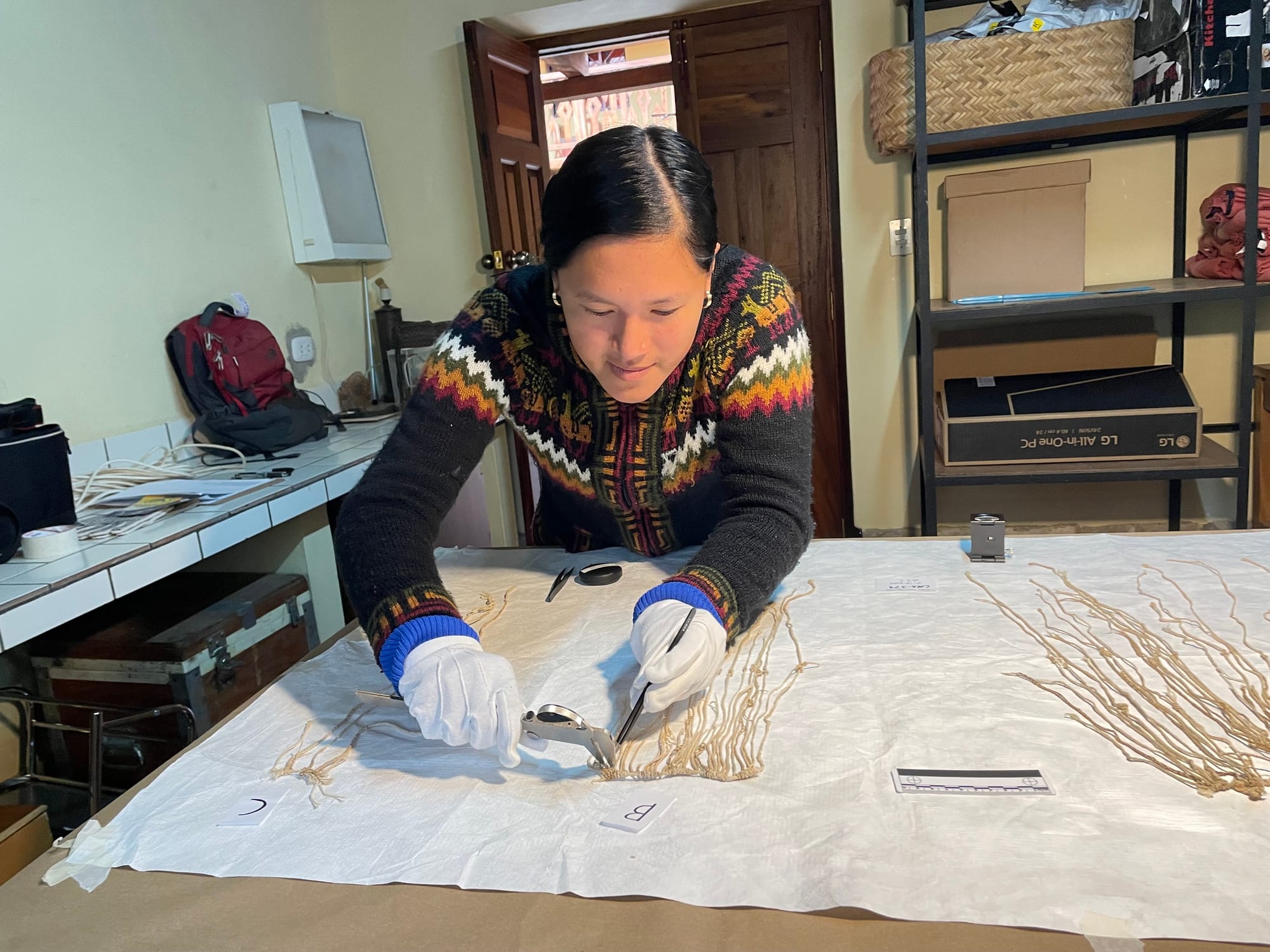
Giovana takes measurements, here cord diameters, as she and Mack carefully record the many structural details of the three khipu fragments.
Sliding one cord over another, Giovana and I worked slowly and deliberately, gently easing them apart. As we proceeded, the cords began to separate naturally into three distinct clusters, until the bundle resolved into three khipu fragments. Each fragment consisted of a section of primary cord with varying numbers and groupings of attached pendant cords. When the three fragments first separated, I briefly wondered whether we had uncovered three separate khipus rather than one. However, closer examination of the primary cord structures, color patterning, and cord groupings all indicated that the fragments belonged to a single khipu.
Once separated, it became far easier to guide individual cords into place and lay them out as straight as 500 odd years of entanglement would permit. The initial untangling took us an entire day, and as the evening arrived, we gently covered the three fragments to return to them in the morning. The cords had been quite patient with us, and I am sure they needed to rest just as much as Giovana and I did.
The following day, Giovana and I began recording the khipu fragment structures—measuring cord lengths, assessing knot types, taking cord diameters, recording yarn colors, etc.
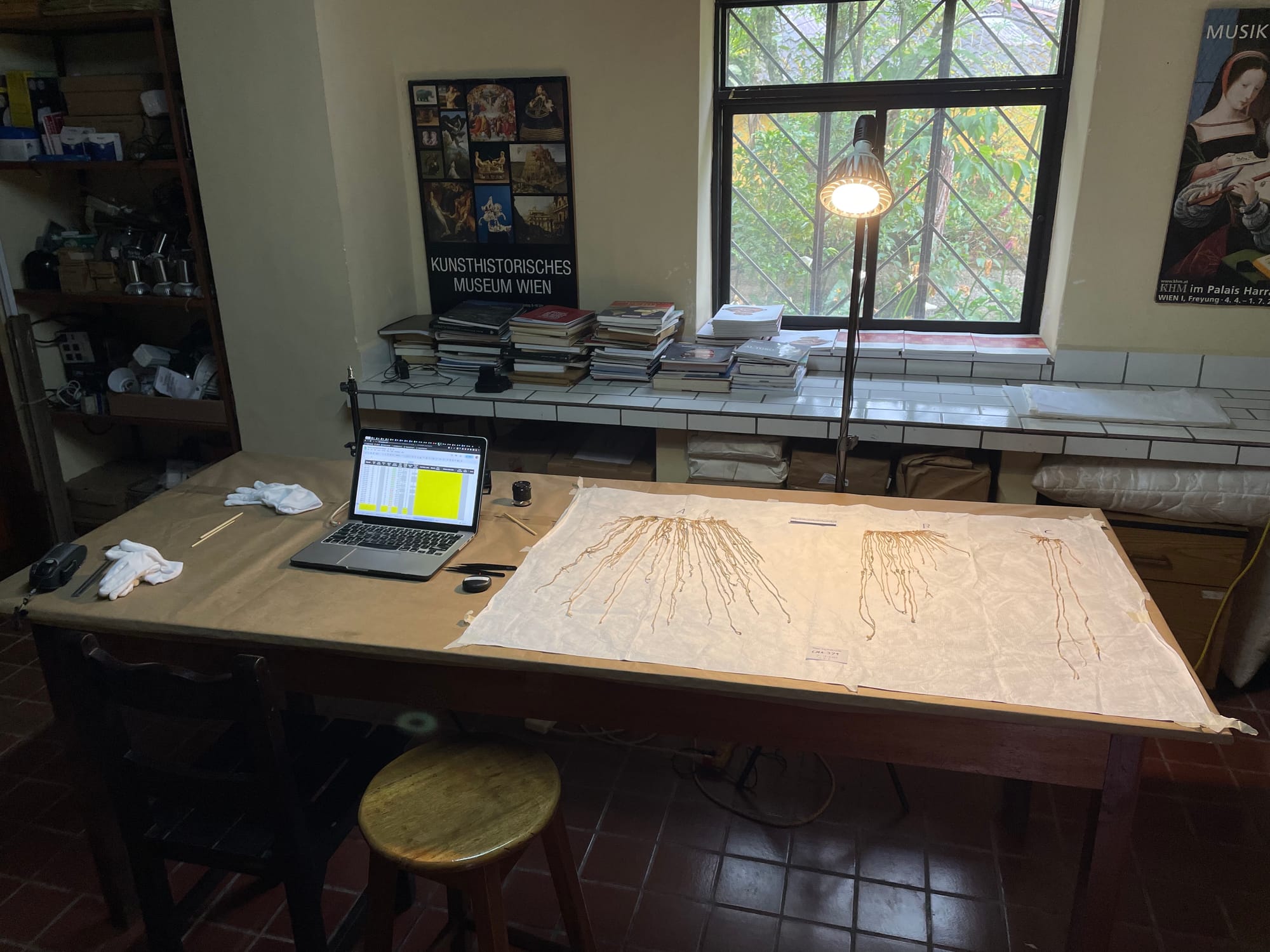
A view of Mack and Giovana’s makeshift “khipu lab” set up at Museo Leymebamba in the summer of 2023.
Untangling this khipu was a privilege I will not soon forget.
Too often, we overlook the time and labor committed to the care and preservation of the objects we study in museums—the hours of unseen preparation that stabilize and conserve an object before it is ever displayed or analyzed. Untangling this khipu gave me a renewed appreciation for the many hours of labor on which my research, and that of many others, depends upon before we can even begin our studies. Still, as always, we must carefully document these processes and remain mindful of any transformations that may be irreversible. In doing so, we must also acknowledge the long and winding path each object has taken before arriving in our hands.
Fiber is grown. Cords are twisted. Knots are tied. Khipus are born, used, and eventually retired. They rest for centuries—sometimes longer—untouched, until hands find them again. Until that time, fiber dries, cords tangle, and knots grow brittle.
We ask much of these objects, which owe us nothing. I am grateful for the opportunity to work with them on their own terms. To untangle, but not untie, gives khipus their best chance to speak to us while respecting their khipukamayuq’s original intent.
See Von Hagen and Guillén (1998). ↩︎
Unmounted, free-floating khipus are certainly preferred by me—and by several of my colleagues—because a free khipu is far easier to study than one rendered immobile by stitching. Still, many museums favor mounted khipus, since they can be safely displayed upright rather than flat, which requires far less exhibition space. Plus, sewing the cords to a backing can stabilize fragile elements and distribute the object’s weight more evenly for when it is displayed at an angle or upright. ↩︎
You can read more about my daily khipu toils in a short piece I wrote for Harvard’s In Situ magazine (see FitzPatrick 2024). ↩︎
I am extremely grateful to both Giovana and Wilder for all the help and support they have given me during my time working in Museo Leymebamba—I cannot thank them enough. I am also deeply grateful to Sonia and the Museo Leymebamba staff, who were consistently hospitable and kind during each of my research visits. ↩︎
For examples of, and evidence for, unrolled khipus, see FitzPatrick (2025). ↩︎
Urton (2007, 46–47) notes that several khipus from the so-called 257 Set, recovered from the tombs of Laguna de los Cóndores, were untied from each other. ↩︎
For a good example, see Thompson’s (2024, 9–10) discussion of KH0083. ↩︎
Bibliography
FitzPatrick, Mackinley. 2024. “The Daily Life of a Khipologo.” In Situ. Fall Semester: 8–12.
FitzPatrick, Mackinley. 2025. “Primary Questions: A Survey of Inka-Style Khipu Primary Cords.” Preprint, SocArXiv, June 28. https://doi.org/10.31235/osf.io/hqkcj_v1.
Thompson, Karen M. 2024. “A Numerical Connection Between Two Khipus.” Ñawpa Pacha 45 (1): 83–104. https://doi.org/10.1080/00776297.2024.2411789.
Urton, Gary. 2007. The Khipus of Laguna de Los Cóndores. Nuevas Imágenes.
Von Hagen, Adriana, and Sonia Guillén. 1998. “Tombs with a View.” Archaeology 51 (2): 48–54.

Comments ()