
The “Waterfall” Khipu Set and Indigenous Political Organization in the 16th Century
Indigenous Political Organizations According to Historical Documentation
In my research on indigenous political organization in central Peru[1], I focused on describing the political entities recorded in the declarations of indigenous curacas (landlords) given during colonial visitas between 1543 and 1562.
The curacas typically reported in two ways: (1) by answering questions posed by the inspectors using a pre-designed questionnaire, and (2) through declarations based on the reading of their khipus. The declarations made by the caciques (local leaders) based on the reading of their khipus were translated from Quechua into Spanish and then copied by a notary, thus constituting a legally binding document. These documents, or khipu texts, can be classified into three categories: (1) khipu texts on the hierarchical organization of the curacas, (2) khipu texts on population, and (3) khipu texts on tribute. I have called the three types of khipus that would have served as the original source (1) pachaca khipus, (2) people khipus, and (3) tribute or mita khipus[2].
The chiefdoms I discussed in the aforementioned study were the Chupachos, Queros, Mitimaes, and Yachas of Huánuco[3]; the Pallascas, Taucas, and Corongos in Conchucos[4]; and the Cantas of the Lima highlands[5]. In less detail, I also discussed the Aymara-speaking Chucuitos, Collaguas, and Pacajes, and the chiefdoms of Yauyos and the coast near present-day Lima[6].
In the khipu-texts that describe political organization, people, or tribute, I found three persistent elements: order, grouping, and hierarchy.
Order
Order is reflected in multiple ways; for example, in the geographical location of settlements, which are often named according to a geographical axis of a watershed. The khipus of individuals, for their part, place married men or aucacamayos first. In the khipus of tributes, the first places correspond to clothing, silver, or corn; that is, the product or goods with the greatest value are those listed first. If a khipuconcerns mita (corvée), what comes first is the turn corresponding to work in the fields of the encomenderos.
Grouping and Hierarchy
Grouping and hierarchy are closely related. Political organization is characterized by a nested structure of parts and subparts. Every political organization has different levels that are grouped to form larger entities: from the ayllu or "village" one ascends to the pisca-chunga [7] or the pachaca, from the pachaca to the pisca-pachaca, from the pisca-pachaca to the guaranga, and from the guaranga to the hunu. The ayllus do not always, but often, equate to settlements and have a highly variable number of aucacamayos[8]; Although, in general, they have fewer than fifty members. On the other hand, the pachacas, pisca-pachacas, or guarangas—although they also have a variable number of members—are characterized by having similar numbers among themselves.
According to the census collected during the visita to the Chupachos in 1549, compared with supplementary data from the 1562 visita[9], the Chupachos pachacas had an average number of around 50 aucacamayos. Two or more pachacas grouped together at an intermediate level (between pachaca and guaranga) with between 100 and 200 aucacamayos. By combining several intermediate-level groupings, two pairs of guarangas were formed, with 580 and 553 aucacamayos respectively. All of which totaled 1203 aucacamayos for the four Chupacho guarangas reported in 1549.
There is clear evidence that during Inca times, numerical denominations smaller than the pachaca were in use, allowing for a more precise determination of the quantities of aucacamayos for each curaca. We refer to the statements of most of the Chupacho curacas interviewed in 1562:
"(...) como dicho tiene, avía las dichas guarangas con sus caçiques e otros mandones de pachacas e de çinquenta e de diez e de çinco yndios e de veynte a quien mandavan y con quien tenían quenta (...)" (Diego Xagua en Ortiz, 1967: 29; f. 12r).
"(...) avía un caçique prinçipal de todas las quatro guarangas que nombraua el ynga e nombraua asimismo vn caçique de cada guaranga y prinçipales de cada pachaca que asimismo los nombraba el ynga y los prinçipales de çinquenta e de diez yndios por manera que el ynga los nombrava a todos los que mandavan (...)" (Juan Xulca en Ortiz, 1967: 45; f. 20v).
"(...) avía caçiques de cada guaranga e de cada pachaca e de a çinquenta e de veynte e de diez yndios avía prinçipales (...)" (Pablo Guaman Naupa en Ortiz, 1967: 56; f. 26r).
"(...) dixo que en tienpo del ynga oyó dezir a sus pasados que heran quatro mil yndios e que dellos avía vn caçique prinçipal e de cada guaranga otro e avía caçiques de pachaca e de diez e veynte e çinquenta yndios e sobre todos ellos que los mandava el caçique prinçipal (...)" (Juan Bautista Yupachaui en Ortiz, 1967: 60; f. 29r).
"(...) avía prinçipales de çiento e de treynta e de diez yndios e de quinientos (...)" (Diego Masco en Ortiz, 1967: 65; f. 32r).
"(...) e avía otros prinçipales que tenían çiento e otros çinquenta e a diez yndios (...)" (Francisco Ninapaucar en Ortiz, 1967:70; f. 35r).
"(...) e que cada guaranga tenía dos caçiques prinçipales e avía prinçipales de pachacas e de a çinquenta e de diez yndios (...)" (Martin Capari en Ortiz, 1967: 81; f. 41r).
"(...) dixo que en tienpo del ynga heran quatro guaranga e de cada guaranga avía dos caçiques e otros prinçipales de pachacas e de çinquenta e menos yndios (...)" (Baltasar Guacache en Ortiz, 1967: 88; f. 45r).
According to the eight curacas interviewed, smaller political entities were described by the approximate number of their members: 10, 20, 30, or 50. For larger entities, they used three terms: pachaca, pisca-pachaca, and guaranga. The curacas' statements are of great interest because they consistently indicate terms that were used during Inca times but were falling out of use a few years later. In 1562, when the visita took place, the curacas only used the terms pachaca and guaranga to describe their villages and stopped naming pisca-chungas or pisca-pachacas.
Another verifiable fact is the discrepancy between the expected number of pachacas or guarangas and the figures reported in 1549 or 1562. The four chupacho guarangas, which should have equated to 4,000 aucacamayos, only contained 1,202, and there is no clear evidence of such a radical demographic collapse in that short period. For example, the mitimaes of Cusco declared that their population remained stable at around 200 aucacamayos. It is possible that the discrepancy was exacerbated by an additional factor: the curacas' desire to rise in social status, which led them to claim a higher rank than they actually held. The Incas would have taken great care to ensure precision in their terminology, as the hierarchy was linked to a system that encouraged population growth: a system that granted curacas (local rulers) a greater number of wives according to their rank. This system of incentives and rewards would have disappeared in parallel with the Inca loss of power.
Another piece of information that emerges from colonial documentation regarding indigenous organization is the information about forms of tribute. Tribute was usually distributed in a roughly proportional manner, with the proportions remaining constant, but with exceptions. For example, when different ecological zones affected the production of corn or potatoes, a fact evident in Huánuco between the Chupachos who lived in valleys and the Queros who lived at high altitudes where corn did not grow (Chirinos, 2024: 327). The descriptions by Polo Ondegardo (2013 [1560-1570]), Cieza (1985 [1553]), and Matienzo (1967 [1567]) inform us about the curacas' capacity to distribute or divide tribute and are fundamental primary sources that confirm the existence of equitable procedures for distributing tribute.
An Initial Analysis of the "Waterfall" Khipu Set
The research on the indigenous organization mentioned so far has been based on the study of colonial documents. So how can we relate what historical documentation tells us to the information we can extract from the archaeological khipus preserved in museums and private collections? This is a challenge that cuts across multiple lines of research and remains one of the central analytical challenges in khipu studies (see, for instance, a previous post Have We Found the "Rosetta Khipus"?).
I believe that the khipus contain details about the organization and the aucacamayos that we have not yet identified or systematically analyzed. The archaeological evidence contained in the khipus could better define the organizational structure of the chungas, pachacas, pisca-pachacas, guarangas, and hunus. Thus, the main objective of this post is to attempt to elucidate—even if tentatively—some indications or clues that might characterize pisca-chungas, pachacas, pisca-pachacas, guarangas, and hunus in the khipus.
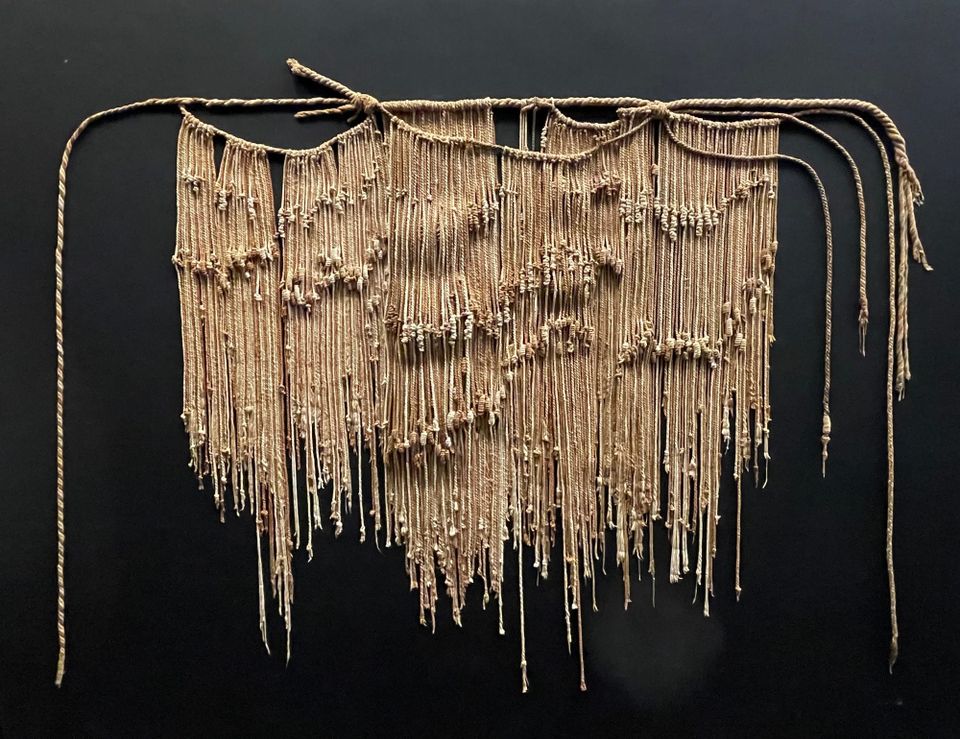
To this end, we analyze the so-called "Waterfall" khipu set[10], a collection of five khipus tied together that are characterized by their common organization: all have groups of three cords that repeat the same color series W, RL, and AB[11]. The W cords have the highest values, with very few exceptions.
Each of the five khipus in the Waterfall set, in turn, has its own characteristics that parallel the numerical characteristics of the political entities described in early colonial documentation. The greatest differences among the five khipus are related to the magnitude of the values knotted on the W cords. The E and B khipus, which have the lowest values, are the only ones with subsidiary cords (the AB cords). There are also differences in the thickness of the cords and the main cords. Khipu E has the smallest quantities and has the thinnest cords. For its part, khipu A has the largest quantities and has the greatest thickness of the main cord. These aspects of khipu construction reinforce the importance of the magnitude of the numbers represented by the knots.
General Characteristic in Waterfall Khipu Set
The first position in each group is white (W) and has the greatest magnitude. The exception is seven groups located at the end of khipu C, where the order of magnitude is RL > W > AB.
The most frequent order of magnitude in each group is W > RL > AB. In khipu D, and in the final groups of khipus E and A, the order changes to W > AB > RL.
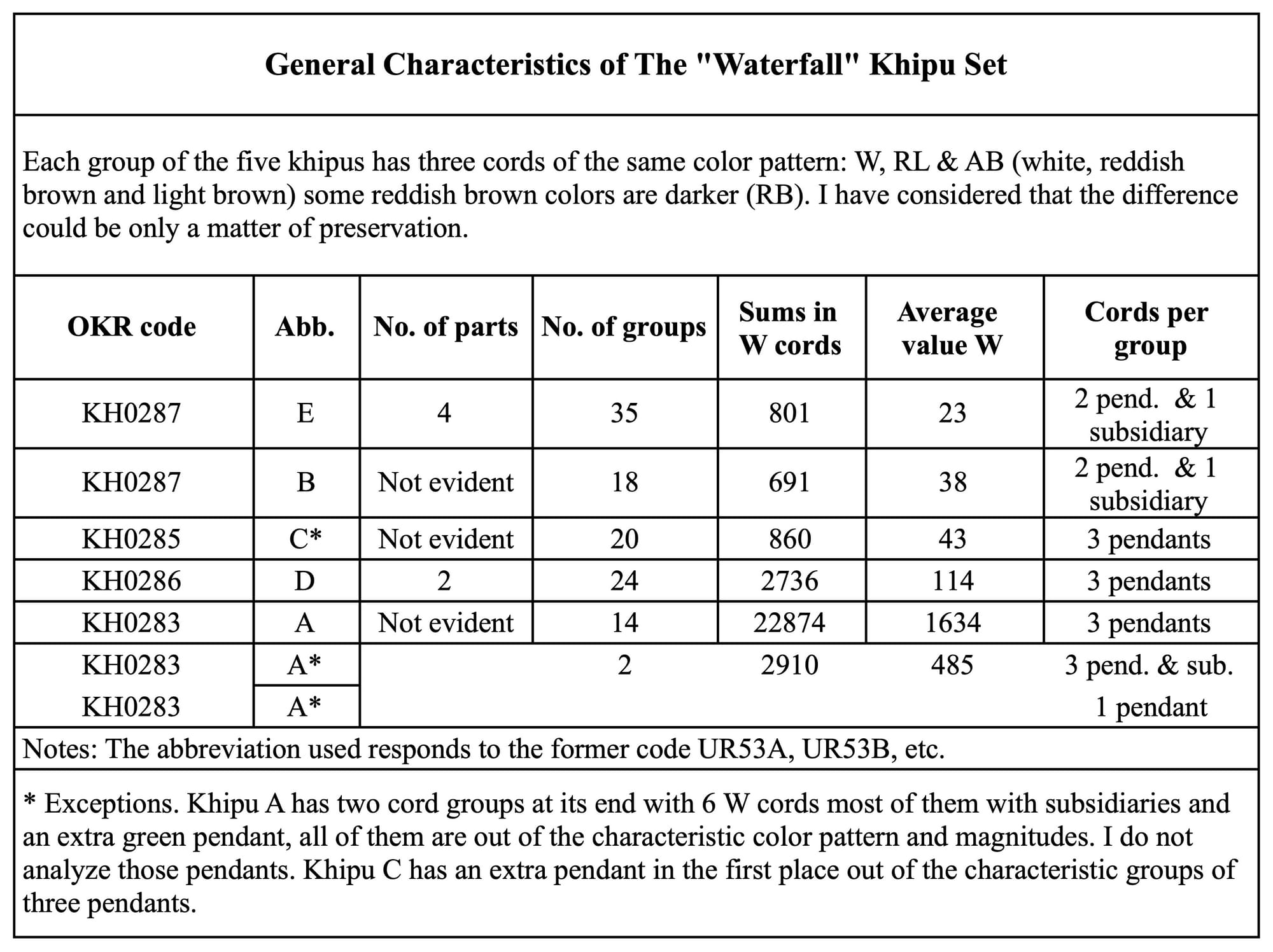
The color pattern allows us to classify the five khipus in the Waterfall set as seriated khipus. Seriated khipus are typically characterized by summations based on position and color; that is, the most relevant sum for analyzing the khipu is not the sum of the three values in each group, as these would represent three different goods or services. If, for example, the W cords represented bushels of corn, the RL cords bushels of beans, and the AB cords baskets of fish, the most significant sums, by color, would be W+W+W... RL+RL+RL... and AB+AB+AB...etc., calculated with respect to the total of the same products shared with other groups within their organization. The sums W+RL+AB would likely not be good indicators of how tributes were distributed among the different groups (e.g., pachacas, groups of pachacas, or guarangas), especially if they represent goods of different value[12].
The numerical characteristics of the Waterfall khipu set show quantities on the white cords (W) whose individual value or sum is approximately equivalent to the quantities usually attributed to ayllus, pachacas, guarangas, and hunus in historical documentation.
Based on these characteristics, I hypothesize that the five Waterfall khipus may represent political entities similar to those that could have existed on the central or southern coast of Peru; for example, in Pachacamac or Ica, where it is noted that there were hunus, guarangas, pachacas, and ayllus. The groups of three cords would represent the basic polities described in each khipu. The quantities represented on the white cords could be bushels of corn, clothing, or some form of mita of labor service, which would be equal to or directly proportional to the number of aucacamayos.
To support this hypothesis, it is necessary to begin by verifying the existence of two elements that are not immediately apparent in the Waterfall khipu set: the nested groupings of parts and subparts, and the use of proportions.
Indigenous political organizations were composed of guarangas, piscapachacas, pachacas, and pisca-chungas; that is, of different levels in hierarchical progression, where the lowest hierarchical levels are integrated into the middle ones, and the middle ones into the highest. What we find in the documentation are political entities that, starting from ayllus, form pachacas; starting from pachacas, form piscapachacas, which in turn form guarangas, and guarangas that form hunus. Groupings of sets are usually composed of two to seven entities (pisca-chungas, pachacas, pisca-pachacas, or guarangas). We know of no political entities composed of 20 pachacas or 14 guarangas without any intermediate smaller parts. Our hypothesis is that we should find something similar in the khipus that have been preserved from the Inca period.
Therefore, taking concrete examples: the 18 groups of khipu B or the 14 groups of khipu A should have parts and subparts even though the khipu's spacing has not indicated them. Since the parts and subparts do not appear in either the color series or the spacing of the main cord, we must look for other ways to recognize these parts. To identify them, we will rely on proportions and show partial examples of parts in four of the khipus, excluding khipu C, which is very similar to B.
Parts and Subparts in Khipus and Some Ways to Identify Them
We have identified several examples of khipus that have groupings of parts and subparts that are not evident from the spacing of the pendants on the main cord. For example, in khipu KH0123, the Aschers established parts based on the color pattern and magnitude. In khipu KH0051, three groups of nine cords are recorded, of which six are brown and three are white; but based on the numerical relationships between the quantities and the presence or absence of subsidiaries, I found that the six brown cords should be analyzed into two subparts of three cords each[13]. In khipu KH242, the last three cords of each group form a cluster that is clearly distinguishable by its different magnitude, which is repeated twice, in the same places, every four groups[14].
In the case of the Waterfall khipu set, identifying the parts and subparts presents a challenge, as there seem to be few objective elements that provide criteria for dividing the parts. However, I suggest that they offer some clues:
1. There is a clear paired organization in khipu D and partially also in khipu A. Khipu D shows a paired structure. In each pair, the pendant W of the first group of a pair is always greater than the pendant W of the second group of the pair (for example, 311>255; 107>62; etc.). In khipu A, which has 7 pairs of groups, the same occurs as in khipu D in 5 of its 7 pairs (10 groups out of 14).
2. There are subparts indicated by sums that connect results in two different khipus. Part IV of khipu E has a fairly close correspondence with 4 groups of khipu B or C (B and C are similar in many of their cords).
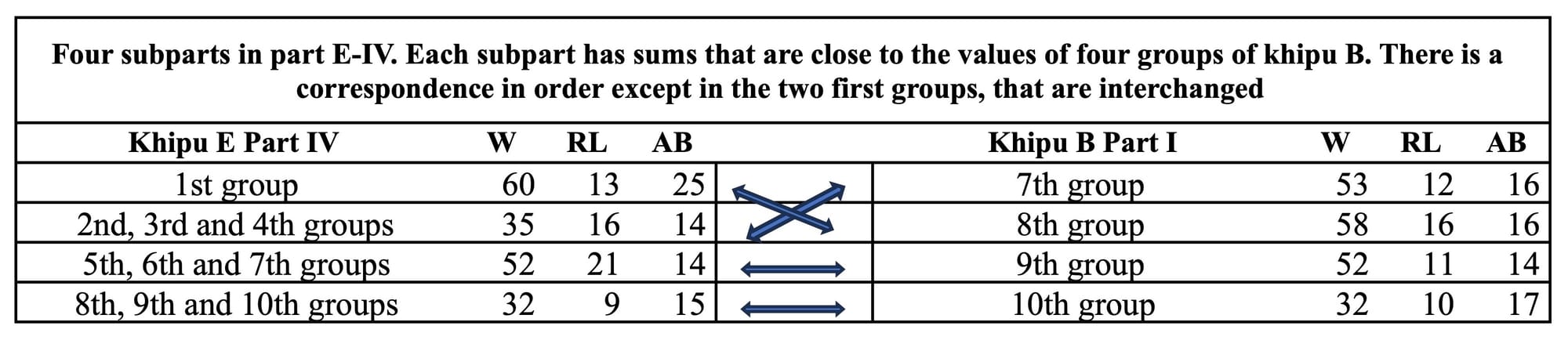
The 10 groups of Part IV of khipu E could be divided into four subparts that are summed in the cords of khipu B.
3. The knot directionality code indicates subsets in khipu C. Khipu C has 9 groups in the central part whose knots have a Z direction, different from the rest of the knots. We call these 9 groups "Part Z". The four groups preceding "Part Z" have significantly lower quantities than those recorded on the RL and AB cords of Part Z. Additionally, the seven groups following Part Z are distinguished by being the only set of groups (in the entire Waterfall set) where the value of the RL pendants is greater than that of the W cords. We conclude that the Z directionality of the knots in khipu C would indicate a different part or sub-part.
4. The hanan/lurin division[15] is a fundamental characteristic of every indigenous Andean political entity. This characteristic alone would allow us to propose parts that divide any khipu that appears to represent a larger political entity into two halves. One possibility, the simplest, would be to divide them into the same number of groups in each part. Another possibility, which seems more likely to me, is that the parts are composed of approximately similar quantities on the W cords; this corresponds better to the numerical equivalencies found in the guarangas and pachacas of the documentation.[16]
However, all the aforementioned methods for identifying parts and subparts, while important indicators, are still insufficient to determine how to divide khipus B, C, and A into parts. I believe that the existence or absence of proportions can be a more objective criterion to better support the division into parts and subparts in the case of khipus B, C, and A. I will begin by showing parts and subparts in khipus E and D, khipus whose parts are indicated by spacing on the main cord and whose analysis is therefore less risky.
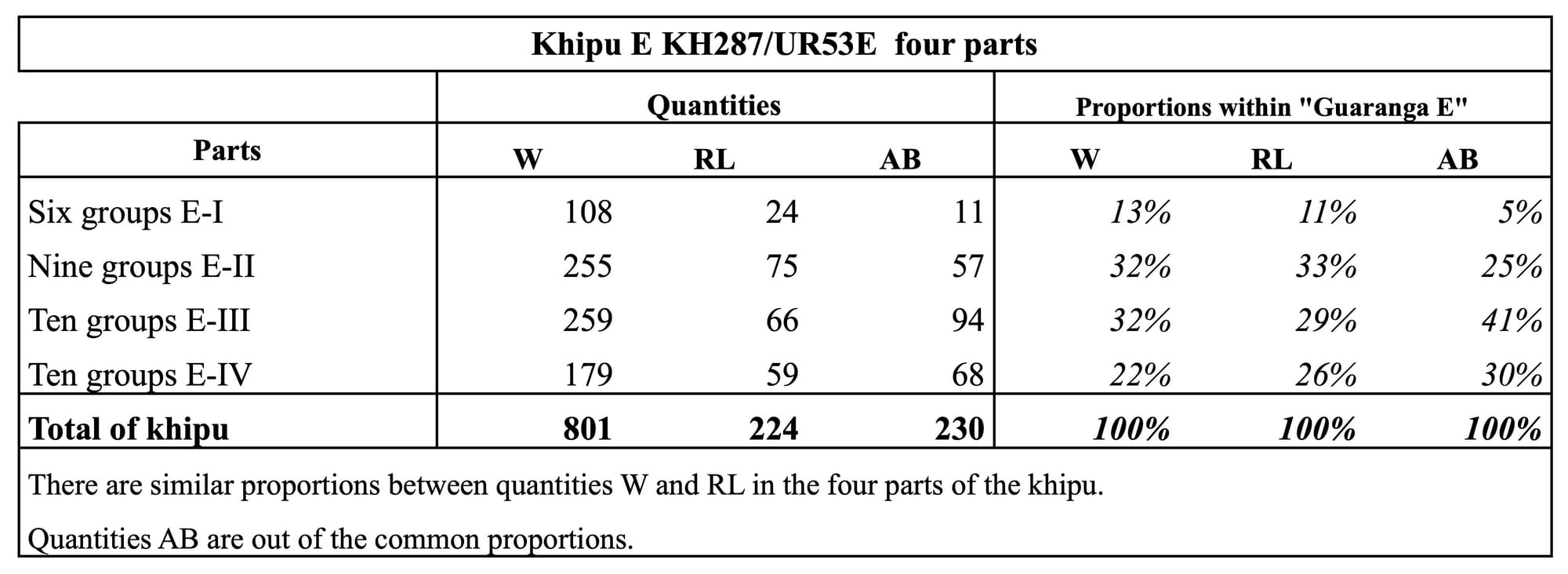
In khipu E, the parts are indicated by spacing, and the calculation of their sums shows that there are approximate proportions relative to the whole khipu. The proportions of the parts occur only between the values of cords W and RL; the quantities on cords AB are out of proportion. We consider this circumstance sufficient to propose that a relative proportionality exists, as it coincides with what is described in colonial documentation, where proportions are generally approximate and do not affect all products. There may always be goods that depend on different ecologies or on the presence of "specialists" in producing a particular product and therefore fall outside the proportions.
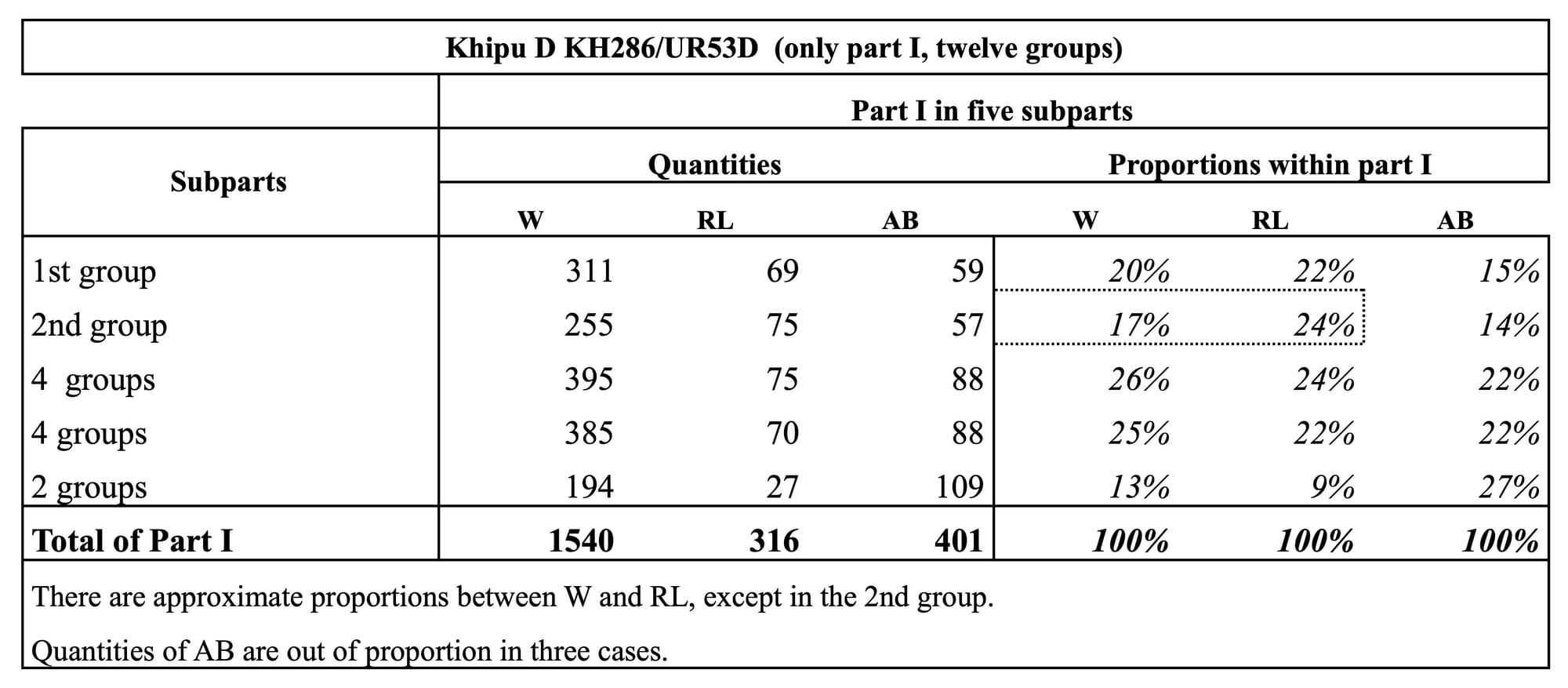
In khipu D, the proportions must be calculated with respect to the total of their respective parts and not with respect to the entire khipu. Khipu D is clearly separated by spacing into two parts. Additionally, we have divided it into five subparts: two subparts are the first two groups, which have a different magnitude than the rest of the groups, and three additional subparts that bring together several pairs of groups with common characteristics. When calculating the proportions, we will see that there are approximate proportions in 5 of the 6 subparts that affect cords W and RL; several values of cords AB fall out of proportion.
In khipu B, we also see common proportions in the values of W and RL; but the cords AB are again out of proportion.
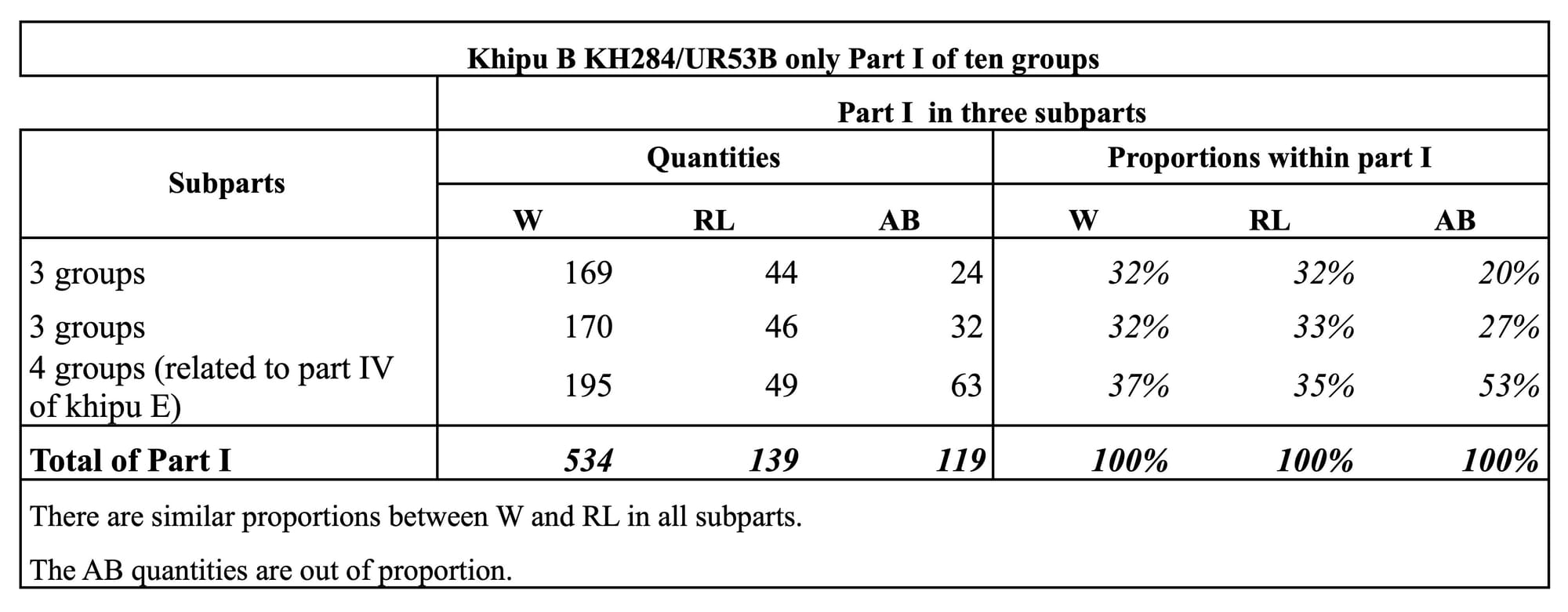
I acknowledge that these divisions into parts and subparts are experimental or, to some extent, arbitrary; other methods of separation would produce similar results even without defining subparts. However, I have considered that the methods described allow for a more concise view and are closer to the documented cases we studied.
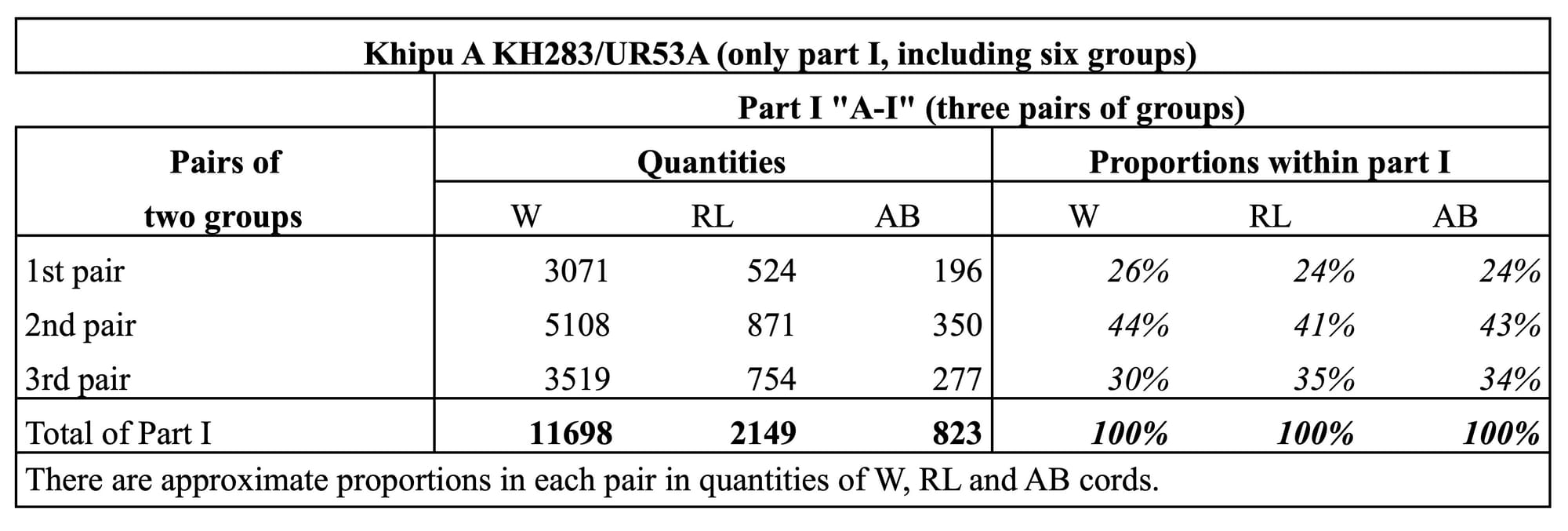
In khipu A, I applied the same procedures to establish two parts and, within them, three subparts, and we found proportions that, in this case, include the values of the AB cords. In the case of khipu A, for the proportions to be visible, we must group the parts in pairs, as this allows them to complement each other.
Conclusions
What I have presented here are only initial advances in a research project that seeks to identify structures in khipus that are similar to the political entities described in early colonial documentation. The Waterfall khipu set is an extraordinary example, as they are five khipus that display numerical patterns encompassing almost the entire range of political organizations existing in the Inca period.
Interpreting the details of each khipu, with the inherent difficulties of analysis, motivates us to search for clues that we are progressively trying to accumulate. We aim to find recurring patterns in increasingly larger sets of khipus, thus allowing us to interpret this crucial aspect of khipus—certain characteristics in the preserved khipus: i.e., systematic order, where the first position is especially significant; hierarchical groupings ranging from the ayllu to the pachaca, guaranga, and hunu; and approximate proportions among the different groupings to distribute tax obligations in a roughly equitable manner.
One final comment: I believe that some research on khipus has mistakenly focused only on partial aspects, isolating them from their internal and external connections—a situation I am not unfamiliar with[17]. The researcher responsible for originally describing the values of the Waterfall khipu set, for example, analyzes khipus B and C while neglecting the systematic numerical connections that exist among the khipus of the entire Waterfall set[18].
Chirinos, Andrés. 2024. "Organización político-territorial en el Perú central del siglo XVI. Un estudio por medio de análisis espaciales SIG y textos quipu como fuentes." Doctoral Thesis, La Universidad Nacional de Educación a Distancia. ↩︎
I discuss the pachaca khipus in Chirinos, 2024: 144-148; for the khipus of individuals and tributes (Chirinos, 2024: 150-152). ↩︎
Chirinos, 2024: 295-346. ↩︎
Chirinos, 2024: 203-209. ↩︎
Chirinos, 2024: 164-179. ↩︎
Chirinos, 2024: 276-294. ↩︎
The literal meanings of these terms are pisca-chunga 'fifty', pachaca 'one hundred', piscapachaca 'five hundred', guaranga 'one thousand', and hunu 'ten thousand'. However, when these same terms refer to Indigenous political organizations, they generally mean that such organizations comprise a certain number of aucacamayos or tributaries (also called 'married men'), a number that does not necessarily correspond to the numerical definition. In this different sense, these terms indicate an organizational structure where the pachacas are subordinate to the pisca-pachacas, the pisca-pachacas to the guarangas, and the guarangas to the hunus. It is likely that in the larger units (guarangas and hunus) the equivalence was never very precise (Murra 2002: 216-217; Zuloaga, 2012: 45). For other researchers, the number of pachacas and guarangas would be almost identical to the literal number (for example, Julien, 1988). I will return to this point later. ↩︎
Aucacamayo means 'men fit to war' and was the term used for what the Spanish later called 'married men' or 'tributary men.' In practice, they were the heads of households capable of performing any work in the service of the Inca and formed the basis upon which labor was distributed. The Incas and the various political organizations that shared a common overarching structure needed to know the number of their aucacamayos to distribute tribute equitably, a matter of utmost importance and one of the main functions of the curacas (local rulers). ↩︎
The results of this census are summarized in two tables (Chirinos, 2024: 270-271). The sum of the data from the survey yields 1203, although the inspectors' report gives 1202. ↩︎
The set of five khipus nicknamed "Waterfall" by Gary Urton are five khipus tied together (initially coded as UR53A, UR53B, UR53C, UR53D, and UR53E) housed in the museum of the Banco Central de Reserva of Peru. Their current designation codes are KH0283, KH0284, KH0285, KH0286, and KH0287. The term "Waterfall" refers to the raveled ends of many cords, which create a waterfall-like appearance at the lower edge of the khipus. In this article, we will refer to them as khipus E, B, C, D, and A, using Urton's original designations. but ordering them from the khipu with the lowest average value on its white cords (khipu E) to the khipu with the highest average value on those cords (khipu A). ↩︎
W = white, RL = light reddish brown, and AB = light brown. These color codes were created by Marcia and Robert Ascher in the late 1970s to more easily encode cord colors. For a complete list of all the Ascher color code abbreviations, see pages 22--25 in Ascher and Ascher (1978), Code of the Quipu Databook. ↩︎
However, the sum of three products, even if they are different, can have several aspects of interest for the analysis of the demand for goods or production, since it can show us approximate proportions of consumption or demand for goods. There would also be special interest if the assets were of similar value. ↩︎
Chirinos, 2010: 270-277. ↩︎
Chirinos, 2010: 263. ↩︎
In the highlands of central Peru, the sections were usually called allauca/ichuca (right and left). ↩︎
The number of aucacamayos was approximately similar among the three guarangas of the Conchucos in 1543 (Chirinos, 2024: 192); likewise among the pachacas and pisca-pachacas of Canta in 1549 (Chirinos 2024: 177); among the two pachacas of the mitimaes (Chirinos, 2024: 323); and among the pachacas of the chupachos counted in 1562 (Chirinos, 2024: 327). ↩︎
In an analysis that I now consider flawed because it failed to prove the existence of a pattern justifying the relationship found, I discovered that one khipu had sums that corresponded to a special value (73326) (Chirinos, 2010: 249-251). ↩︎
See Urton (2017: 143-153). One specific point proposed by Urton is that the recto and verso attachment of the pendants indicates a Hanan/Urin division. It seems more justifiable to me to propose that khipus B and C, given their great similarity, refer to the same political entity, at least in the parts that are repeated in both khipus. ↩︎
Bibliography
Ascher, Marcia, and Robert Ascher. 1978. Code of the Quipu Databook.
Chirinos Rivera, Andrés. 2010. Quipus del Tahuantinsuyo: Curacas, incas y su saber matemático en el siglo XVI. Editorial Commentarios.
Chirinos Rivera, Andrés. 2024. "Organización politico-territorial en el Perú central del Siglo XVI. Un estudio por medio de análisis espaciales SIG y textos-quipu como fuentes." Universidad Nacional de Educación a Distancia.
Cieza de León, Pedro de. 1985. Crónica del Perú. Segunda parte. 2nd ed. PUCP - Academia Nacional de la Historia.
Julien, Catherine. 1988. "How Inca Decimal Administration Worked." Ethnohistory 35: 257--79.
Matienzo, Juan de. 1967. Gobierno del Perú -1567. Edited by Guillermo Lohmann Villena. Travaux de l'Institut Français d'Etudes Andines. Lima-Paris.
Murra, John V. 2002. El mundo andino. Población, medio ambiente y economía. PUCP-IEP.
Ortiz de Zúñiga, Iñigo. 1967. Visita de la provincia de León de Huánuco en 1562 Tomo I. Edited by John V. Murra. Universidad Nacional Hermilio Valdizán.
Ortiz de Zúñiga, Iñigo. 1972. Visita de la provincia de León de Huánuco en 1562 Tomo II. Edited by John V. Murra. Universidad Nacional Hermilio Valdizán.
Polo Ondegardo. 2013. El orden del Inca: las contribuciones, distribuciones y la utilidad de guardar dicho orden (s. XVI). Editorial Commentarios.
Urton, Gary. 2017. Inka History in Knots: Reading Khipus as Primary Sources. University of Texas Press.
Zuloaga Rada, Marina. 2012. La conquista negociada: guarangas, autoridades locales e imperio en Huaylas, Perú (1532-1610). Instituto de Estudios Peruanos.

Comments ()