Memories of Bob Ascher, author of Code of the Quipu
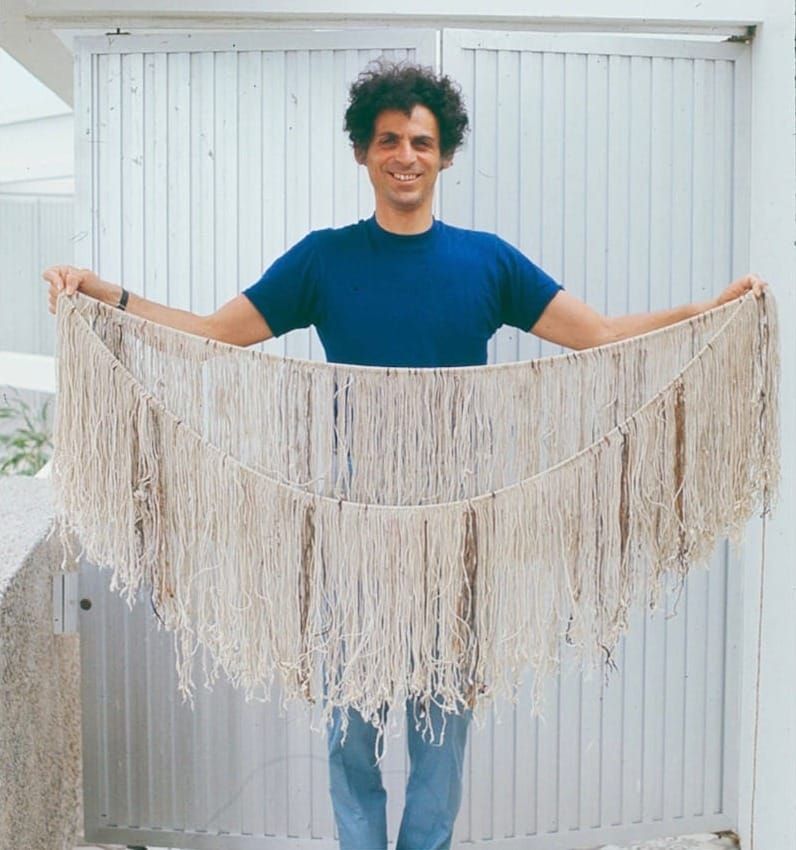
Writing under the pseudonym, Puck, Bob described his situation in the Anthropology Department at Cornell in the 1980s:
“I spend two days a week on campus...I never visit the office of another professor except when I must do so on business...In my view, I run my own small college within a university two days a week. The rest of the University can go to hell with itself...And I think that the institution needs me a great deal more than I need it.”
Bob’s office expressed his separateness from his colleagues when I knew him as an undergraduate anthropology major from 1982-1986. A large tree trunk dominated the centre of his room. For class we sat on the floor, cross-legged, around the tree trunk while he spoke from his desk chair on the side. It seemed like a California hippy heaven in the midst of Cornell’s cold and formal Ivy-league McGraw Hall. He asked us to call him by his first name, which was considered very transgressive at the time. A native of Queens, educated at UCLA, Bob Ascher was, in the words of a colleague “the most remarkable person I have met. Bob most certainly did not fit the mold of the traditional university professor in ways that aggravated some of his colleagues, endeared him to others, and drew students to his classes in droves”.[1]
Initially an archaeologist, Bob promoted the use of ethnographic analogy, challenging the prevailing belief that ethnography held little relevance for archaeological interpretation. His classic study of Seri fisherman in northern Mexico, “Ethnology for Archaeology”, demonstrated the crucial role of ethnography for understanding the material culture of the past.[2] He cared deeply about language and encouraged me to study Quechua. In his contribution to a seminal study on human evolution, Bob theorised how a primate call system could have provided the basis for language. He once scandalised me by impishly recounting the following nugget that he had buried in this piece,
“If early primate history had for some reason promoted precision of control of the sphincter, and of the accumulation and discharge of intestinal gas, speech sounds today might be anal spirants”.[3]
He seemed amused at my confusion about how to respond to this statement from a professor.
Bob and his wife Marcia had published Code of the Quipu in 1981, a year before I began studying anthropology at Cornell.[4] At the time, Cornell was one of the main centres of Andean anthropology in the US, yet Bob had virtually no relationship with the Andeanists in the department. Foremost among the anthropologists of the Andes at Cornell in those days was Billie Jean Isbell. Tall and imperious, she strode through the hallways dressed in flowing scarves and drab homespun skirts. She convened frequent Andean seminars which Gary Urton usually attended, driving down from Colgate where he was on the faculty. They had become friends when both were graduate students of Tom Zuidema at the U. of Illinois. Zuidema’s Dutch structuralism reigned supreme among the Andeanists then, inspiring a spate of community studies organised along structuralism paradigms. If khipus ever were mentioned in Billie Jean’s seminars, it was in the context of the ceque system—the ritual lines radiating from the centre of Inka Cuzco which, for Zuidema, epitomised everything important in Andean life and culture. It seemed sufficient to compare the ceque system—combining calendrics, kinship, religion, and politics—to a giant khipu, in which sacrificial sites were like the knots on a khipu pendant.
Gary Urton’s first book, At the Crossroads of the Earth and Sky, on the ethno-astronomy of a small Andean village, Misminay, was published in 1981, the same year as Code of the Quipu. In his introduction to Gary’s book, Zuidema suggested that the ritual cycles of agriculture and astronomical observation in Misminay fulfilled the same functions that khipus served for the Inka state:
“In Misminay, a small village, we find a highly complex system that integrates observed cycles of the sun, moon, and stars with agricultural cycles of planting and harvesting, of crop cycling, and of cycles pertaining to wild animals and plant life...Despite the intricacies of the system in mnemotechnic terms, it serves the local needs of a village and does not have to be recorded by the people themselves in a formal way. In the case of Cuzco, the political-administrative needs of the empire made it necessary to register local calendars on quipus, knotted cords. By selecting comparable data, quantifying dates, and noting volumes of produce, Inca administrators recorded situations much like those in Misminay. But their records were of more importance to the administration than to the local people themselves, who relied on the more subtle correspondences between cycles, rhythms, and rituals.” R. Tom Zuidema (Forward, Urton, 1981, pp. xiv-xv).
In Zuidema’s view, there was no need for local Andeans to utilise khipus, since all the important functions of khipus were fulfilled by the local calendrical and ritual knowledge. If modern Andeans did occasionally keep string records, it was not for anything essential or comparable to the Inka state khipus that tied together the imperial calendrical and agricultural cycles.
Other Andeanists at Cornell then included the famous archaeologist Tom Lynch, who later would leave Cornell in a cloud of harassment scandals, becoming the executive director of the Brazos Valley Museum in Bryan, Texas in 1993. Craig Morris, a curator at the American Museum of Natural History, had a part-time appointment and taught an amazing class on Andean ethnohistory. An archaeologist of the Inkas, Craig guided us through how we should read the Spanish chroniclers. Linguist Donald Solá taught the only course in Quechua available in the US at the time. After taking all of Sola’s classes on Quechua, I did a year-long independent study class under his direction on the Quechua text of the Huarochiri Manuscript, a 17th century Quechua account of ritual and myth. The only Spanish translation then available was that of Arguedas, a highly literary “translation”; Salomon and Urioste’s excellent English translation had not yet been published. My term paper focused on the Quechua text of Chapters 20 and 21 which described the dream/visions of Llocllay Huancupa. The Getty Manuscript of Martín de Murúa’s chronicle had not been published yet, so I had no way of knowing that Murúa told us that there were special khipus to encode dreams.
In Code of the Quipu, Bob and Marcia relied upon the writings of the Spanish chroniclers to understand the Inka culture that produced khipus. They clearly did not feel that Dutch structuralism held the key to interpreting Andean khipus. I remember one memorable afternoon in Bob’s office in 1985 when he expressed to me his bitterness and frustration that his book on khipus was ignored by his colleagues studying the Andes. Unfortunately, this alienation also separated Bob from the Andean textile studies that were advancing at the time. Andean textile specialists Christine Franquemont and Elayne Zorn were both graduate students at Cornell then. If Bob had spent time thinking about khipus in the context of the Andean textile arts, his work may have taken different directions.
By the 90s, the community oriented Andean ethnography approach would fall out of fashion. Political economy models would come to dominate within cultural anthropology until they were displaced by the “ontological turn”. When Gary Urton eventually accepted an endowed Chair at Harvard, he acknowledged the importance of the Ascher’s khipu database and sought to expand it in anticipation that computational analysis could lead to decipherment. The contributions of Bob and Marcia Ascher to khipu studies have gotten their due, even if this acknowledgement came later than Bob had hoped.
When one reads through Bob’s obituaries, the theme that shines throughout is his generosity of spirit and his kindness. Thoughtful and caring, he personally brought me flowers when I fell ill my senior year and was in a hospital bed in the campus clinic for a week. In his class on ethnographic film animation, in which we drew images directly onto the film, he patiently helped me, lending me his own drawing pens. I remember clearly the large photo of his wife, Marcia, on his desk. A gifted mathematician, she founded the Math department at Ithaca College. Bob spoke of her with deep love and affection, telling us how she became more beautiful every year as she aged. They had both attended Queens College and married in 1955 after her graduation. They would remain best friends, lovers, and companions for 58 years until her death in 2013. The last ten years of Marcia’s life were marked by considerable debilitating illness. Bob put his many projects on hold to give her all the care that he could during that difficult decade; he passed away within a year of her death.
Saraydar, Stephen C. 2016. “Robert Ascher: Archaeologist, Sculptor, Filmmaker.” Ethnoarchaeology 8 (1): 90–96. https://doi.org/10.1080/19442890.2016.1150628. ↩︎
Ascher, Robert. 1962. “Ethnography for Archeology: A Case from the Seri Indians.” Ethnology 1 (3): 360–69. ↩︎
Hockett, Charles F., Robert Ascher, George A. Agogino, et al. 1964. “The Human Revolution.” Current Anthropology 5 (3): 135–68. https://doi.org/10.1086/200477. ↩︎
Ascher, Marcia, and Robert Ascher. 1981. Code of the Quipu: A Study in Media, Mathematics, and Culture. University of Michigan Press. ↩︎

Comments ()