
Indigenous Accounting and Exchange at Monte Sierpe (‘Band of Holes’) in the Pisco Valley, Peru
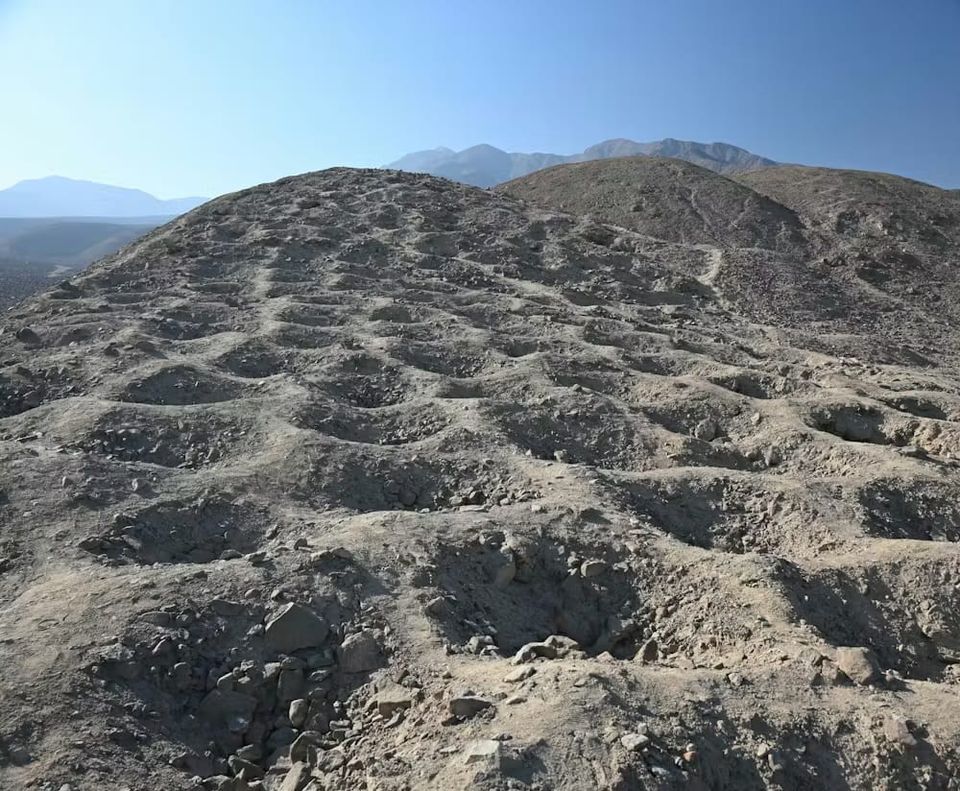
A new article[1] has been published in this month's issue of Antiquity. One of the authors, Manuel Medrano, is a founding member of the KhipuFieldGuide team. It's an intriguing paper, talking about the site of Monte Sierpe, in the Pisco Valley in Peru. Known as the "Band of Holes", the authors integrate drone imagery and microbotanical analyses to suggest that people deposited goods in the holes, perhaps using baskets and/or bundles for transport. They then propose the hypothesis that Monte Sierpe functioned as a barter marketplace before being turned into a large-scale accounting device under the Inca Empire.
Paper Abstract:
Stretching for 1.5km and consisting of approximately 5200 precisely aligned holes, Monte Sierpe in southern Peru is a remarkable construction that likely dates to at least the Late Intermediate Period (AD 1000–1400) and saw continued use by the Inca (AD 1400–1532). Yet its function remains uncertain. Here, the authors report on new analyses of drone imagery and sediment samples that reveal numerical patterns in layout, potential parallels with Inca knotted-string records and the presence of crops and wild plants. All this, the authors argue, suggests that Monte Sierpe functioned as a local, Indigenous system of accounting and exchange.
Paper Excerpts:
A discovery in the Cañete Valley at the major Inca administrative centre of Inkawasi provides a potential clue for interpreting Monte Sierpe. Like Tambo Colorado in the Pisco Valley, Inkawasi is a huge administrative site that may once have been part of the Chincha Kingdom (Castillo, Marcone, Irazabal, Areche, Huerta and Burga 2023). A grid-like array of squares found on the floors of two rectangular sorting spaces in the site’s storage complex could represent standardised accounting units for agricultural produce (Urton and Chu 2015: 512). Khipus were also found in the complex, sometimes in physical association with such produce. The regularity of these squares is comparable to the numerical patterns at Monte Sierpe, suggesting a potentially similar purpose: the counting and sorting of different goods. The segmented and regular arrangement of the holes at Monte Sierpe also finds an analogue in a complex Inca-style khipu excavated near Pisco around the turn of the twentieth century (VA16135a/VA16135b in the Ethnologisches Museum, Berlin) (Figure 9). The pendant cords of this khipu are arranged in 80 distinct groups of similar size, with almost all groups consisting of either 10, (most frequently) 11 or 12 cords. The numbers knotted on the cords exhibit an intricate set of arithmetic interrelationships (Medrano and Khosla 2024), suggesting that it is a surviving record of the kinds of ‘working’ accounting operations that would have characterised functional activity at Monte Sierpe.

VA 16135b (© Ethnologisches Museum, Staatliche Museen zu Berlin, photographs by Claudia Obrocki; made available via CC BY-NC-SA 4.0 licence; figure by J. Osborn)
As an accounting device, each section at Monte Sierpe could have been linked to a particular social group for the payment of tax and the redistribution of commodities. Numerical patterns in layout and variation in the number of holes across sections may correspond to other local khipus and to sixteenth-century tribute lists in the Andes, reflecting differences in tribute levels and/or the number of taxpayers from specific villages and towns. Kin-based units would have been responsible for building and maintaining the holes and depositing goods, such as maize, into the hole sections through the traditional Inca mit’a system (Julien 1988). Each segment might correspond to a social group, whether it was kin-based or location-based. This interpretation coincides with Monte Sierpe’s ideal location for commodity accounting, collection and control between Tambo Colorado and Lima La Vieja.
Two of the authors, Jacob Bongers and Chip Stanish, have also written an article for the public in The Conversation.
Bongers, Jacob L., Christopher A. Kiahtipes, David Beresford-Jones, Jo Osborn, Manuel Medrano, Ioana A. Dumitru, Christine Bergmann, et al. “Indigenous Accounting and Exchange at Monte Sierpe (‘Band of Holes’) in the Pisco Valley, Peru.” Antiquity, 2025, 1–19. https://doi.org/10.15184/aqy.2025.10237. ↩︎

Comments ()