
Counting the Khipus: How Many Are There to Study?
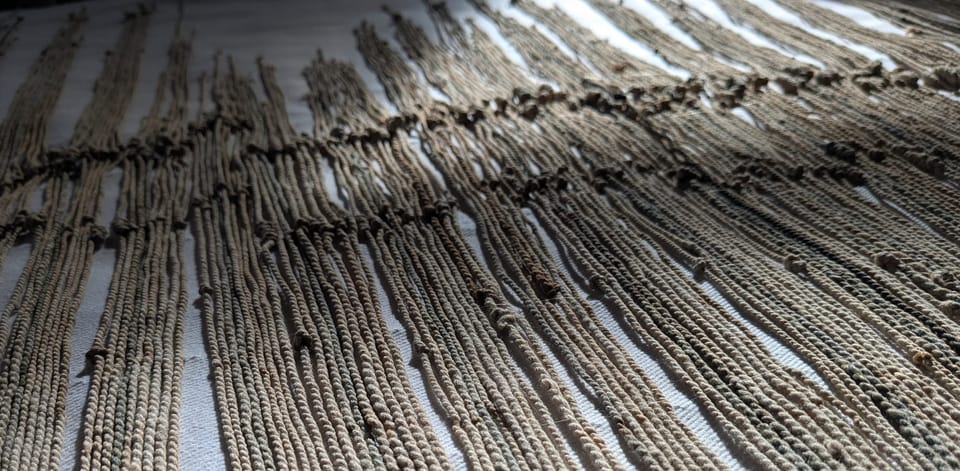
You may have noticed in Ashok’s post – Can We Use AI for Khipu Decipherment? – that “recent surveys put the total number of surviving khipus today at around 1,300 to 1,600” and wondered how that count came about? The short answer: with a whole lot of hard work and the contributions of many people! The longer answer, though, is a story worth telling.
The first published survey of known khipus was in L. Leland Locke’s important 1923 book The Ancient Quipu or Peruvian Knot Record (in English).1 Drawing on research in the prior century, he mentioned 45 khipus, some in brief passing and others in detail, all with either a photograph or illustration.
Decades later, in 1949, another giant in the field of early khipu research, Carlos Radicati di Primeglio, published Introducción al estudio de los quipus (in Spanish).2 He assessed the 50+ khipus published to that date and added six from his own collection to the public record.
While not readily findable beyond academic institutional access, the next significant khipu survey was in Carol Mackey’s 1970 PhD thesis Knot Records in Ancient and Modern Peru (in English).3 By my count, she mentions 220 khipus in her text: (i) 77 already published khipus; (ii) 98 khipus new to the literature; (iii) 19 previously published ‘modern’ khipus (see Side bar 1); (iv) 23 modern khipus new to the literature; and (v) 2 khipus are mentioned without being included in these four listings. It is worth noting that, with respect to listing (i), Mackey notes that the “list of published quipu does not include all known sources, only those used in this study” (p.212).
Side bar 1: archaeological versus modern khipus
Khipu researchers sometimes find it helpful to distinguish between ‘archaeological’ and ‘modern’ khipus. The former are usually those found, or believed to be found (noting that the find place of a significant proportion of khipus is simply not known, due to the collecting practices in the late 1800s and early-mid 1900s), in archaeological contexts and interpreted as belonging to the pre-conquest and early colonial periods. I think of these as the khipus that researchers most commonly investigate in their decipherment efforts and as one avenue for unlocking how the Inka and their precursor societies used khipus. ‘Modern’ khipus are usually taken to mean those that were/are found in local use or stewardship in the Andes. You may also find the terms patrimonial or ethnographic used. Examples include those collected in the late-1800s by Max Uhle,4 the khipus in Tupicocha,5 the large khipu-object in Rapaz,6 or the recently revived funeral khipus.7 Any of these that remain where they were created, and not now held in an institutional collection, I like to identify as ‘in community’.
In 1976 Radicati di Primeglio updated the listing of known ‘archaeological’ khipus in his paper El sistema contable de los Incas: Yupana y Quipu (in Spanish).8 His listing has 86 objects, though curiously he only added 6 from Mackey’s work.
The landmark work of Marcia and Robert Ascher was published in 1978: Code of the Quipu: Databook (in English).9 Their extensive research added 209 more (coded AS10-AS200, some khipus codes are split into sub-khipus) to the 9 they published in 1972 (AS1-AS9).10 In their 1988 book, Code of the Quipu: Databook II (in English),11 they added a further 18 khipus (AS201-AS215). By this point, they had identified 560 khipus, of which they had recorded features in detail for over 230 of them. Though their listing did not include all khipus mentioned in the literature: they “do not tag quipus that are merely mentioned in passing; nor do we tag those specimens that are described in such a way as to be inadequate for purposes of interpretation.” (1988, p.4).
While only briefly mentioned, a 2011 text12 stated that (at the time) the Khipu Database project (KDB)13 listed “789 extant samples in museums and private collections around the world. … [and] contained information on 452 samples” (p. 320). Skipping forward to 2017, also using the KDB data, a survey by collection and region was published in Inka History in Knots: Reading Khipus as Primary Sources (in English).14 While later reviews identified some small errors in this table, the overall count it stated was 923 khipus, with 544 having been studied in detail (i.e., data provided to the KDB).
In 2021 Manuel Medrano published his book Quipus: Mil años de historia anudada en los Andes y su futuro digital (in Spanish).15 Following what must have been a great deal of work, he substantively updated the count to 1386 khipus, organised by museum/collection. A large portion of the updated count came from a more accurate count of khipus in the Museo Nacional de Arqueología, Antropología e Historia del Perú (MNAAHP) and the Berlin Ethnologisches Museum. It must be noted that this survey focused on objects that could be located within a collection and was not intended to include in-community khipus or those that were known but whose location could not be confirmed.
The latest revision to this count has been derived from work I have been undertaking for the last two years: the khipu-bibliography cross-reference resource (the 'khipu-biblio').16 This work was intended to provide researchers a list of all literature for each known khipu, and an extra benefit has been an updated khipu count. After counting unique khipus mentioned in the literature, allocating to collections/museums if known (and where possible checking this against their online collection catalogues or confirming by email – for which I cannot be more thankful to the incredible generosity of museum staff!), the count of 1386 has so far increased to 1655 khipus. Then, adding the 25 khipus that remain in community (where the large multi-khipu found in Rapaz is counted as one object), and 42 identified in the literature which could not be tied to a collection (i.e., published information was not sufficiently detailed), brings the total to 1724 khipus. However, it is probable that there are duplicates in this count due to how this listing has been constructed. Therefore, it might be cautious to say that there are around 1650-1700 documented khipus.
Of these, approximately 750 are in South America, 300 in North America, and 610 in Europe. As an Australian, I am hoping a khipu will one day be found in one of our public collections.
Side bar 2: what counts as a khipu?
In my work, and that of many researchers, we take care not to include cords that are loose or otherwise not attached to a primary cord in a survey count. To be counted as a ‘khipu’ for the purposes of this survey, there needs to be a fragment of primary cord with cords attached. This is not to devalue disassociated or detached cords, for they certainly contribute to an understanding of production. We have examples of primary cords less than 5cm long included in the survey. Some of these fragments with broken primary cords may in fact belong to the same original khipu, but for now they are considered distinct objects. Khipu boards, researched by Sabine Hyland, Sarah Bennison, and colleagues,17 are not included in this survey for they are a distinct, though associated, object type.
The survey information has also been visualized on the map seen below. When you click on a collection button you are provided with a count of how many khipus are believed to be held and how many of those are in the Khipu Field Guide (KFG). My goal is to be part of turning many of the orange (only some khipus in KFG) and red (no khipus in the KFG) buttons to green (all khipus recorded in KFG).
Side bar 3: paper khipus
When the question ‘how many khipus are known about’ is asked, it is important to mention that an additional source of knowledge is the body of writing left (mostly by Europeans) following the conquest. In these writings, there is evidence of khipus that existed and were used within the originating communities. As Mackinley wrote in his blog post, researchers are yet to securely align any such written evidence with one or more surviving khipus. However, there are some very detailed accounts of information submitted to legal proceedings, particularly those published by Martti Pärssinen and Jukka Kivaharju (in English).18 These are often so detailed that they have been referred to as ‘paper khipus’, in that a representation of the khipus may possibly be reconstructed from the information recorded. The survey and khipu count written about here does not include these paper khipus, though they continue to be an important avenue for research.19
All that said, there are undoubtedly khipus in private collections that are not known to the public record or to khipu researchers.
There can also be little doubt that there are khipus in public collections and museums that are invisible to their administration records and therefore researchers. These may have arrived within a larger collection in decades past and have yet to be fully accessioned. Or may not yet be recognized as khipus – as the Aschers have said, the khipu is “an object that resembles a worn out mop” (1978, p.1), and collections staff may not be familiar with how small a khipu can be, because those in the literature are more often the spectacular examples.
A key goal of projects like The Khipu Field Guide and Open Khipu Repository is to make data available to anyone who wants to be part of the ongoing adventure of understanding these remarkable objects. With each additional khipu incorporated, the collective potential for new insights expands, strengthening the foundations for progress toward 'decipherment'. I sincerely hope—and am optimistic—that many more of the approximately 1650-1700 known khipus not yet represented will be added in the near future, further enriching this shared endeavor.
Resources
Khipu-Bibliography Cross-Reference Resource (KBCR): https://doi.org/10.26188/25661322 (be sure to check for the latest version, as this gets updated occasionally)
Updated khipu count, by collection (based on KBCR): https://doi.org/10.26188/28786049 (check for the latest version)
Map of khipus by known collection location: https://www.google.com/maps/d/edit?mid=1-ISOaywX0a5nhVYT08RdCkMyXdoJcTQ&usp=sharing
Endnotes
1 Locke, L. Leland. 1923. The Ancient Quipu or Peruvian Knot Record. American Museum of Natural History, New York. (English) ↩︎
2 Radicati di Primeglio, Carlos. 1949-1950. Introducción al estudio de los quipus. Documenta, Revista de la Sociedad Peruana de Historia 2(1):244-339. Reproduced as a monograph in 1951, and in 2006. (Spanish) ↩︎
3 Mackey, Carol. 1970. Knot Records in Ancient and Modern Peru. PhD dissertation, Anthropology, University of California, Berkeley. (English) ↩︎
4 Uhle, Max. 1897. A Modern Quipu from Cutusuma, Bolivia. Bulletin of the Free Museum of the University of Pennsylvania 1(2):51–63. (English) ↩︎
5 See: Salomon, Frank. 2002 [1997]. An Introduction to the ‘‘Quipocamayos’’ of Tupicocha, Huarochirí. In Narrative Threads: Accounting and Recounting in Andean Khipu, edited by Jeffrey Quilter and Gary Urton, pp.293-319. University of Texas Press, Austin. (English) ↩︎
6 See: Ruiz Estrada, Arturo. 1981. Los quipus de Rapaz. Centro de Investigación de Ciencia y Tecnología, Huacho. (Spanish) ↩︎
7 See: Tun, Molly, and Filomeno Zubieta Núñez. 2016. The funerary and tributary quipus of Cuspón and Chiquián: today and yesterday. Archeology and Society 31:403-421. (English) ↩︎
8 Radicati di Primeglio, Carlos. 2006 [1976]. El sistema contable de los Incas: Yupana y Quipu. In Estudios sobre los quipus, edited by Gary Urton, pp. 265-354. Universidad Nacional Mayor de San Marcos, Lima. (Spanish) ↩︎
9 Ascher, Marcia, and Robert Ascher. 1978. Code of the Quipu: Databook. University Microfilms, Ann Arbor. (English) ↩︎
10 Ascher, Marcia and Robert Ascher. 1972. Numbers and Relations from Ancient Andean Quipus. Archive for History of Exact Sciences 8(4):288–320. (English) ↩︎
11 Ascher, Marcia, and Robert Ascher. 1988. Code of the Quipu: Databook II. University Microfilms, Ann Arbor, Michigan. (English) ↩︎
12 Urton, Gary, and Carrie J. Brezine. 2011. Khipu Typologies. In Their Way of Writing: Scripts, Signs, and Pictographies in Pre-Columbian America, edited by Elizabeth Hill Boone and Gary Urton, pp.319–352. Dumbarton Oaks Research Library and Collection, Washington. (English) ↩︎
13 Initially designed and managed by Carrie Brezine at Harvard. The Khipu Database project was rebadged as the Open Khipu Repository in 2021. https://doi.org/10.5281/zenodo.18025748 ↩︎
14 Urton, Gary. 2017. Inka History in Knots: Reading Khipus as Primary Sources. University of Texas Press, Austin. (English) ↩︎
15 Medrano, Manuel. 2021. Quipus: Mil años de historia anudada en los Andes y su futuro digital. Planeta, Lima. (Spanish) ↩︎
16 Thompson, Karen M. 2025. Connecting Objects and Literature: A Case Study with Khipus, the “Khipu-Biblio Cross-Reference.” Advances in Archaeological Practice 13:2, pp.273–290. (English) ↩︎
17 Hyland, Sabine, Sarah Bennison, and William P. Hyland. 2021. Khipus, Khipu Boards, and Sacred Texts: Towards a Philology of Andean Knotted Cords. Latin American Research Review 56(2):400-416. (English) ↩︎
18 Pärssinen, Martti and Jukka Kiviharju. 2004. Textos andinos: corpus de textos “khipu” incaicos y coloniales. Instituto Iberoamericano de Finlandia: Departamento de Filología, Univ. Complutense de Madrid, Madrid. (English) And: Pärssinen, Martti, and Jukka Kiviharju. 2010. Textos Andinos: Corpus de textos khipu incaicos y coloniales, Vol.2. Instituto Iberoamericano de Finlandia, Madrid. (English) ↩︎
19 Murra, John V. 1975 [1973]. Las Etno-Categorías de Un Khipu Estatal. In Formaciones Económicas y Políticas Del Mundo Andino, edited by John V. Murra, pp. 243-254. Instituto de Estudios, Lima. (Spanish) And, Manuel Medrano. 2023. The ‘Paper Khipus’ of the Early Colonial Andes. In Bookkeeping Without Writing: Early Administrative Technologies in Context, edited by Lucy Bennison-Chapman (Peeters), pp.200-230. (English) ↩︎

Comments ()